


 Topic Options
Copyright © 1998
Cadman Enterprises Ltd

Welcome to the Graham Slee Audio Products Owners Forum  Open to all owners plus those contemplating the purchase of a Graham Slee HiFi System Components audio product and wishing to use this forum's loaner program: join here (Rules on posting can be found here) This website along with trade marks Graham Slee and HiFi System Components are owned by Cadman Enterprises Ltd |
High Frequency hearing loss? |
Post Reply 
|
Page <123> |
| Author | |
Chris Firth 
Moderator Group 
Joined: 16 May 2013 Location: Rossendale, UK Status: Offline Points: 1665 |
 Post Options Post Options
 Thanks(1) Thanks(1)
 Quote Reply Quote Reply
 Posted: 29 Aug 2022 at 3:52pm Posted: 29 Aug 2022 at 3:52pm |
|
I do play things and sing, and in my opinion you're better off not making adjustments in EQ, and just get used to hearing what abuse and age has brought to you.
You can't really compensate for what you've lost, and if you do compensate with EQ you'll have everybody else vacating the area pretty sharpish.
|
|
 |
|
|
discrete badger
Senior Member 

Joined: 14 Jul 2009 Status: Offline Points: 482 |
Post Options
Thanks(0)
Quote Reply
Posted: 29 Aug 2022 at 4:17pm |
|
Sorry to have to say but I've had little success with trying to use normal tone controls to correct issues with specific frequency regions downstream. In my case it was the room having resonant modes. The tone control always seemed to be centred at the wrong frequency. On the occasion where I tried to use a tone control that had an adjustable centre frequency, it also didn't work effectively due to the shallowness of the curve either side ("Q" factor).
I have a feeling that the "tone control" box you mention might suffer from not offering a band centred on the appropriate frequency - which seems to be approximately 5Khz. So in order to achieve approximately the 4db lift in that region, the opening gambit would perhaps be to set the 8Khz band up 4db. But - depending on the "Q" implemented, this would likely make the region around 4Khz slightly too loud, and the region 6Khz to 12Khz much too loud, which could make 4Khz to 6Khz sound quieter, because it will be judged by the ear relative to that. These frequency regions are key for engaging listening, and if they're too hot it might be hard to maintain interest. Maybe the manufacturer of this box would be as attentive to the needs of their prospective customers as a certain proud yorkshireman and be willing to answer a query as to whether their product would be suitable for this use, and if there is any doubt, offer to remove it with a trial/demo unit? IMO correction of this level of focus is a job for digital PEQ, because the adjustability needed (centre frequency, level, slope) is the nature of the beast. Unfortunately adding any device to the chain is going to threaten SQ, in particular if it does AD/DA conversion and especially if it isn't too expensive. Correcting the digital sources alone with minimal SQ loss and cost-effectively would be relatively easy to do, it's the turntable side that's more problematic. Faced with a related dilemma (room modes, as mentioned) I opted to live with boomy LPs and correct the digital only with a pro-audio PEQ box offering both analogue and digital IO, of which I used only the digital. This was fine for me as most of my listening was and remains digital, but everybody is different of course. These days I am fortunate that my amp can now do PEQ internally so I can enjoy corrected LPs as well. The effect of the correction is so powerful that I find the system unlistenable without it, but my room is weird and >10db at several frequencies around 100Hz - right in the "boom" region.
|
|
|
|
|
Graham Slee
Admin Group 

Retired Joined: 11 Jan 2008 Location: South Yorkshire Status: Offline Points: 16314 |
Post Options
Thanks(0)
Quote Reply
Posted: 29 Aug 2022 at 6:05pm |
|
Taking the Fletcher Munson curves based on heathy hearing tests, I've inverted it to show graphically the perceived levels to a flat response. Indicating the 70dB sort of average listening room sound pressure, I drew in your 4dB loss between 4kHz and 6kHz (dotted curve). Like Chris, I think it would be better to accept it as wear and tear. Perhaps it's been like it for some time, but you've only just been made aware? 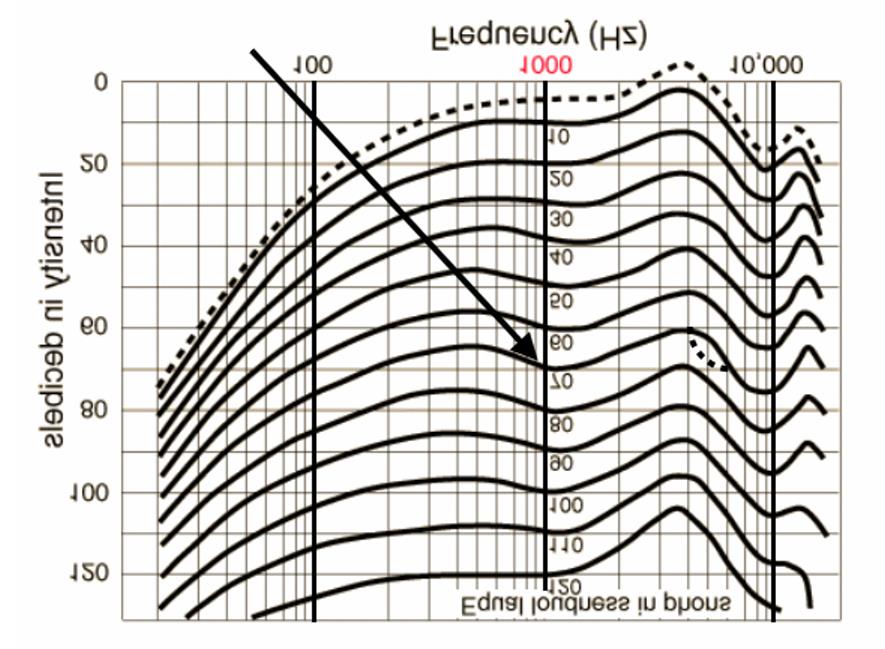 As db suggested, it would be very difficult to recreate the inverse of this small half octave deviation, requiring a Q that would give the same shape. Tone controls and graphic EQ will be some way out, as their Q's and turnovers will most probably miss the frequency range and Q shape by a country mile. However, one lucky thing you have is a male vocals sibilance filter!
|
|
|
That none should be able to park up and enjoy the view without a smartphone and the knowledge in how to use apps
|
|
|
|
|
Ash
Senior Member

Joined: 18 Mar 2013 Location: Dorset Status: Offline Points: 4360 |
Post Options
Thanks(0)
Quote Reply
Posted: 29 Aug 2022 at 6:25pm |
|
I don't think I've ever been able to hear anything close to 20kHz.
15kHz would be my uppermost estimate and I don't abuse my hearing.
|
|
|
We do not see things as they are. We see things as we are.
|
|
|
|
|
Chris Firth
Moderator Group
Joined: 16 May 2013 Location: Rossendale, UK Status: Offline Points: 1665 |
Post Options
Thanks(0)
Quote Reply
Posted: 29 Aug 2022 at 6:44pm |
|
I remember someone generating 19KHz tones, and me being able hear them distinctly, when I was 14 years old.
I remember hearing the very, very subtle sound of a cuckoo clock bellows being minorly engaged, and the resulting partial "cuc" sound - all the adults around swore I was hearing things, but it was definitely heard by me.
In my late 20s I used to be able to hear the lower end harmonics of the bats flying around here when I was walking the dogs. Hearing degradation, and its various causes, are a fact of life. I use power tools at work, spend many hours driving about, go to concerts. football matches, had chemotherapy, and none of it is beneficial to my hearing. Having a reference point, in my case acoustic guitars, is very beneficial in keeping a balanced view of what it is I'm listening to. |
|
|
|
|
Mikeh
Senior Member

Joined: 04 Dec 2018 Location: Yorkshire Status: Offline Points: 617 |
Post Options
Thanks(0)
Quote Reply
Posted: 29 Aug 2022 at 7:08pm |
|
Thank for all the feedback. I understand that it probably not worth the complexity (& expense) to make this, relatively minor, adjustment. It seems dsp or peq devices would be the way to go and I'm not prepared to go that route nor Roon at the present.
I do wonder if I would actually notice the difference so might try a free trial software solution for computer feeds. I don't use the laptop usb feed much but it is there as an option. I've been amazed at how the human body can adapt for other medical changes and I guess the brain allows us to accommodate some degree of frequency before intervention is needed. Just as a matter of interest did you know that when cochlea implants are used for severe hearing loss, the immediate 'sound' the recipient hears is a bit like morse code then within minutes the brain converts the sound (say speech) into recognisable form. My brother told me this after he had the operation following 50 years as a hearing aid user. The brain is a marvel!
|
|
|
Mike
Technics sl1210g with Victor U-2 or Technics EPC-205C mk4 Accession MM, Majestic + Proprius, Solo ULDE Innuos Zen mini mk3 streamer Harbeth P3ESR XD paired with 2x REL t5x |
|
|
|
|
BackinBlack
Senior Member

Joined: 05 Feb 2012 Location: Hinton, N'hants Status: Online Points: 2139 |
Post Options
Thanks(0)
Quote Reply
Posted: 29 Aug 2022 at 8:07pm |
|
In my late 60s I suffered a series ear "infections" and partial loss of hearing, the diagnostic procedures included X-Rays, MRI scan and hearing tests. Medication to keep the Eustachian tubes clear resolved the infections. On the basis of just the age and noise related hearing loss I was entitled to NHS hearing aids. I subsequently got NHS behind the ear aids, which were a true revelation. After an initial period of getting accustomed to the aids I had several sessions with very helpful NHS audiologists so fine tune them. I'm now on my 2nd pair and wouldn't be without them, support from the NHS audiologists has (with one exception - when they don't understand what sibilance is - you know you're on a loser!) been brilliant, helped by me being able to understand and describe audio reproduction. I may have been lucky in having skilled audiologists to set them up. Nonetheless I think they're preferable to adjusting amplifier response, particularly when I'm not the only one listening.
If you can, get an NHS hearing test and referral for hearing aids. Nothing to lose. Ian
|
|
|
Just listen, if it sounds good to you, enjoy it.
|
|
|
|
|
Post Reply
|
Page <123> |
 Tweet
Tweet
|
| Forum Jump | Forum Permissions You cannot post new topics in this forum You cannot reply to topics in this forum You cannot delete your posts in this forum You cannot edit your posts in this forum You cannot create polls in this forum You cannot vote in polls in this forum |
Forum Software by Web Wiz Forums® version 12.01
Copyright ©2001-2018 Web Wiz Ltd.
This page was generated in 0.055 seconds.
Copyright ©2001-2018 Web Wiz Ltd.
This page was generated in 0.055 seconds.