High Frequency hearing loss?
Printed From: Graham Slee Hifi System Components
Category: And the rest
Forum Name: Transducers, Speakers, Mics...
Forum Description: Interested in bi-amping, tri-amping, crossovers, speaker design, miking techniques, EQ - the list goes on
URL: https://www.hifisystemcomponents.com/forum/forum_posts.asp?TID=2182
Printed Date: 27 Mar 2026 at 12:15am
Software Version: Web Wiz Forums 12.01 - http://www.webwizforums.com
Topic: High Frequency hearing loss?
Posted By: Drewan77
Subject: High Frequency hearing loss?
Date Posted: 21 Feb 2014 at 5:42pm
|
I don’t know whether my latest rambling is
of interest to anyone, however I have been curious for a while to test the fact
that hearing deteriorates with age, particularly appreciation of high
frequencies. I can honestly say I don't notice it and have seen numerous references
to neither human hearing nor CDs extending above 20khz. So as a ‘human’ (last
time I looked) and getting on in years, my hearing should be pretty flawed
Curiosity got the better of me a few days
ago. With active crossovers, I am able to use 50th order 300dB/octave
slopes - my ‘unusual’ system configuration accommodates something like this quite easily with super tweeters As an experiment, I progressively used higher crossover points and a fairly high listening volume, the other amps controlling mid & bass
below the crossover frequency were switched out of circuit. This was not music
and obviously quite annoying to listen to, however all I was trying to do was
see what I can still hear above set frequencies and if anything at
all is audible beyond 20khz or on a CD Album used for this: Tony Joe White ‘Closer to the truth’ which is very well mastered, contains a lot of hi-hat and the metallic ring of cymbals. I also have it on LP and CD to be able to compare which I did in ‘real time’ with volumes equalised. All the frequencies below are the lowest level permitted by the crossover, upwards to infinity and beyond as they say… With CD – 18khz+: treble is clearly heard and slightly ‘brittle’ (when switching/comparing to the LP) 20khz+: its still there, reduced in volume 22khz+: Nothing at the listening position, a slight ‘tizz’ on hi-hats audible with my ear close to the tweeter (maybe even a brick wall crossover still bleeds upwards a bit from <20khz?) 25khz+: nothing I can hear With Vinyl – 18khz+: treble sounds clear and quite ‘shimmering’ 20khz+: still clear, slightly less reduction in volume than the CD ie a bit brighter sounding 22khz+: more audible than the CD from the listening chair. Quite a lot still going on but pretty low volume & subtle 25khz+: very slight occasional ‘sssz’ sound - only with my ear very close to the tweeter and only on the high percussion & LP ‘pops/clicks’. To all intents and purposes therefore, nothing much to hear (by the way, slightly audible hiss from the Reflex M is at a lower level than surface noise so irrelevant once the needle hits the disc) With vinyl playback, whenever I return to full range listening but switch out frequencies above 20khz, the music becomes slightly flatter and duller. I don’t think it’s imaginary. With everything back in circuit, it all sounds natural and immediate Conclusion: Maybe my hearing has not deteriorated as it’s meant to be… yet. The higher frequency response on an LP is somehow audible above 20khz even though we are supposed not to hear it, especially at my age and may be contributing to the ‘airier’ and more natural sound that vinyl possesses? The CD high frequencies sound subtly different to vinyl and definitely die off above 20khz (I anticipate the Majestic smoothing the brittleness though…each type of cartridge/DAC will naturally vary so it’s virtually impossible to do a true comparison) None of this is scientific of course but thanks for reading this far ! I am
back listening to music as SWMBO is away for the weekend and have a lot to get through (must remember to brush
the cobwebs off the TV by Sunday evening ------------- Older than I once was, younger than I'll be ............................. Andrew |
 )
)Replies:
Posted By: suede
Date Posted: 21 Feb 2014 at 6:33pm
|
Interesting test and findings Andrew, thanks for sharing it. I read an article a while back (on BBC.co.uk I think it was) which stated that normal hearing deterioration from ageing generally isn't as pronounced in professional musicians as in people in general. Now if this has anything to do with how we use our sense of hearing on a daily basis, how much focus we put on it, then it should apply equally to audio enthusiasts shouldn't it? After all I believe there is such a thing as fine-tuning your sense of hearing, making it more accute to finer details. Maybe this also brings with it some small protection? ------------- Proprius, Reflex M, Solo UL, Bitzie, CuSats & Spatia --------------------------------- Johan |
Posted By: ICL1P
Date Posted: 21 Feb 2014 at 6:47pm
Good God man! Whatever are you talking about? You're a whole week younger than me; a mere youngster! ------------- Ifor ===== Reflex M & ACCESSION M, CuSat50, Majestic DAC, a Proprius pair. |
 Drewan77 wrote:
Posted By: suede
Date Posted: 21 Feb 2014 at 6:56pm
|
I managed to find the mentioned article again: http://www.bbc.co.uk/news/health-14882394 - http://www.bbc.co.uk/news/health-14882394 Seems it's musicians in general, not just the professional kind. ------------- Proprius, Reflex M, Solo UL, Bitzie, CuSats & Spatia --------------------------------- Johan |
Posted By: Drewan77
Date Posted: 21 Feb 2014 at 7:05pm
|
Well Johan, I am not a musician but the amount of live music I listen to should have done permanent damage by now. Maybe there is something in that BBC article. As Ifor may be suggesting that I have only a further seven days before deterioration sets in  , it's just as well that I have a completely free weekend ahead (& I wish I was a whole week younger than that picture of his !) , it's just as well that I have a completely free weekend ahead (& I wish I was a whole week younger than that picture of his !)------------- Older than I once was, younger than I'll be ............................. Andrew |
Posted By: suede
Date Posted: 21 Feb 2014 at 8:24pm
I'm a bit of a recreational musician myself. Playing the guitar and the harmonica, and also used to play the piano when I had one. So if these findings are indeed true and if they apply to discerning music listeners as well then I can safely set my Solo dial all the way to eleven, safe in the knowledge that my ears are quite indestructible.  ------------- Proprius, Reflex M, Solo UL, Bitzie, CuSats & Spatia --------------------------------- Johan |
Posted By: Mikeh
Date Posted: 29 Aug 2022 at 3:14pm
|
An old thread, I know, but better than starting afresh. Having received the results of a recent hearing test, I know my range is down about 4db between 4-6KHz before kicking up again. As the audiologist said, 'a typical cookie bite loss pattern, maybe better than average for age'.i.e old codgers syndrome. Has anyone tried using tone controls to counteract such hearing degradation? I've seen there has been a lot of discussion about tone/ loudness controls in the thread about Graham's 70's design amp but nothing about adding such controls to a GSM system. I've only found one 'simple' analogue tone control,.the Schiit Loki or Lokius, otherwise it seems to be complex graphic equaliser or dsp. I would prefer to 'keep it simple' with minimum addition to the chain between Majestic and Proprius. I'd be interested in any experience /advice in this area. ------------- Mike Technics sl1210g with Victor U-2 or Technics EPC-205C mk4 Accession MM, Majestic + Proprius, Solo ULDE Innuos Zen mini mk3 streamer Harbeth P3ESR XD paired with 2x REL t5x |
Posted By: Chris Firth
Date Posted: 29 Aug 2022 at 3:52pm
|
I do play things and sing, and in my opinion you're better off not making adjustments in EQ, and just get used to hearing what abuse and age has brought to you. You can't really compensate for what you've lost, and if you do compensate with EQ you'll have everybody else vacating the area pretty sharpish.
|
Posted By: discrete badger
Date Posted: 29 Aug 2022 at 4:17pm
|
Sorry to have to say but I've had little success with trying to use normal tone controls to correct issues with specific frequency regions downstream. In my case it was the room having resonant modes. The tone control always seemed to be centred at the wrong frequency. On the occasion where I tried to use a tone control that had an adjustable centre frequency, it also didn't work effectively due to the shallowness of the curve either side ("Q" factor). I have a feeling that the "tone control" box you mention might suffer from not offering a band centred on the appropriate frequency - which seems to be approximately 5Khz. So in order to achieve approximately the 4db lift in that region, the opening gambit would perhaps be to set the 8Khz band up 4db. But - depending on the "Q" implemented, this would likely make the region around 4Khz slightly too loud, and the region 6Khz to 12Khz much too loud, which could make 4Khz to 6Khz sound quieter, because it will be judged by the ear relative to that. These frequency regions are key for engaging listening, and if they're too hot it might be hard to maintain interest. Maybe the manufacturer of this box would be as attentive to the needs of their prospective customers as a certain proud yorkshireman and be willing to answer a query as to whether their product would be suitable for this use, and if there is any doubt, offer to remove it with a trial/demo unit? IMO correction of this level of focus is a job for digital PEQ, because the adjustability needed (centre frequency, level, slope) is the nature of the beast. Unfortunately adding any device to the chain is going to threaten SQ, in particular if it does AD/DA conversion and especially if it isn't too expensive. Correcting the digital sources alone with minimal SQ loss and cost-effectively would be relatively easy to do, it's the turntable side that's more problematic. Faced with a related dilemma (room modes, as mentioned) I opted to live with boomy LPs and correct the digital only with a pro-audio PEQ box offering both analogue and digital IO, of which I used only the digital. This was fine for me as most of my listening was and remains digital, but everybody is different of course. These days I am fortunate that my amp can now do PEQ internally so I can enjoy corrected LPs as well. The effect of the correction is so powerful that I find the system unlistenable without it, but my room is weird and >10db at several frequencies around 100Hz - right in the "boom" region.
|
Posted By: Graham Slee
Date Posted: 29 Aug 2022 at 6:05pm
|
Taking the Fletcher Munson curves based on heathy hearing tests, I've inverted it to show graphically the perceived levels to a flat response. Indicating the 70dB sort of average listening room sound pressure, I drew in your 4dB loss between 4kHz and 6kHz (dotted curve). Like Chris, I think it would be better to accept it as wear and tear. Perhaps it's been like it for some time, but you've only just been made aware? 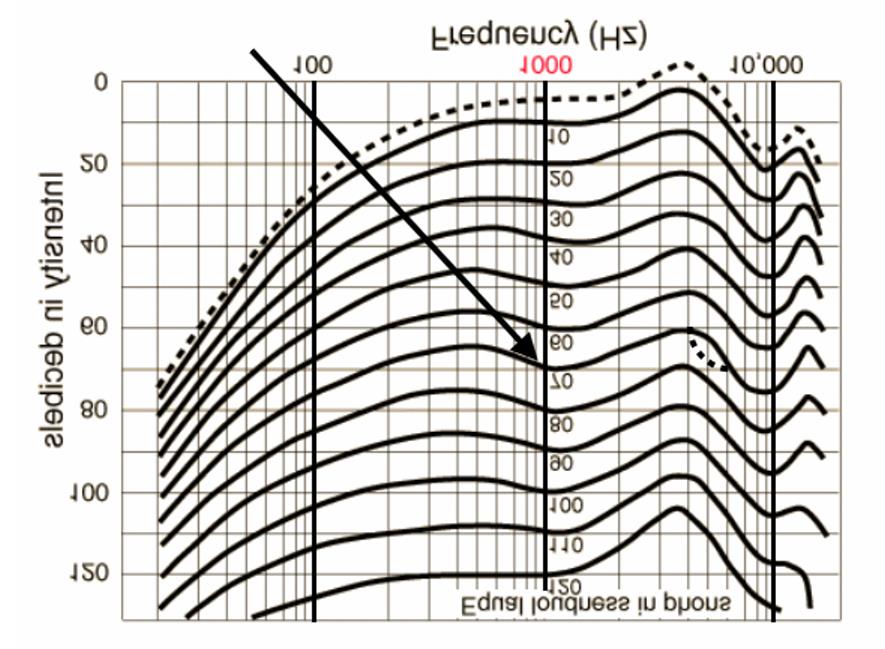 As db suggested, it would be very difficult to recreate the inverse of this small half octave deviation, requiring a Q that would give the same shape. Tone controls and graphic EQ will be some way out, as their Q's and turnovers will most probably miss the frequency range and Q shape by a country mile. However, one lucky thing you have is a male vocals sibilance filter! ------------- That none should be able to park up and enjoy the view without a smartphone and the knowledge in how to use apps |
Posted By: Ash
Date Posted: 29 Aug 2022 at 6:25pm
|
I don't think I've ever been able to hear anything close to 20kHz. 15kHz would be my uppermost estimate and I don't abuse my hearing. ------------- We do not see things as they are. We see things as we are. |
Posted By: Chris Firth
Date Posted: 29 Aug 2022 at 6:44pm
|
I remember someone generating 19KHz tones, and me being able hear them distinctly, when I was 14 years old. I remember hearing the very, very subtle sound of a cuckoo clock bellows being minorly engaged, and the resulting partial "cuc" sound - all the adults around swore I was hearing things, but it was definitely heard by me.
In my late 20s I used to be able to hear the lower end harmonics of the bats flying around here when I was walking the dogs. Hearing degradation, and its various causes, are a fact of life. I use power tools at work, spend many hours driving about, go to concerts. football matches, had chemotherapy, and none of it is beneficial to my hearing. Having a reference point, in my case acoustic guitars, is very beneficial in keeping a balanced view of what it is I'm listening to. |
Posted By: Mikeh
Date Posted: 29 Aug 2022 at 7:08pm
|
Thank for all the feedback. I understand that it probably not worth the complexity (& expense) to make this, relatively minor, adjustment. It seems dsp or peq devices would be the way to go and I'm not prepared to go that route nor Roon at the present. I do wonder if I would actually notice the difference so might try a free trial software solution for computer feeds. I don't use the laptop usb feed much but it is there as an option. I've been amazed at how the human body can adapt for other medical changes and I guess the brain allows us to accommodate some degree of frequency before intervention is needed. Just as a matter of interest did you know that when cochlea implants are used for severe hearing loss, the immediate 'sound' the recipient hears is a bit like morse code then within minutes the brain converts the sound (say speech) into recognisable form. My brother told me this after he had the operation following 50 years as a hearing aid user. The brain is a marvel! ------------- Mike Technics sl1210g with Victor U-2 or Technics EPC-205C mk4 Accession MM, Majestic + Proprius, Solo ULDE Innuos Zen mini mk3 streamer Harbeth P3ESR XD paired with 2x REL t5x |
Posted By: BackinBlack
Date Posted: 29 Aug 2022 at 8:07pm
|
In my late 60s I suffered a series ear "infections" and partial loss of hearing, the diagnostic procedures included X-Rays, MRI scan and hearing tests. Medication to keep the Eustachian tubes clear resolved the infections. On the basis of just the age and noise related hearing loss I was entitled to NHS hearing aids. I subsequently got NHS behind the ear aids, which were a true revelation. After an initial period of getting accustomed to the aids I had several sessions with very helpful NHS audiologists so fine tune them. I'm now on my 2nd pair and wouldn't be without them, support from the NHS audiologists has (with one exception - when they don't understand what sibilance is - you know you're on a loser!) been brilliant, helped by me being able to understand and describe audio reproduction. I may have been lucky in having skilled audiologists to set them up. Nonetheless I think they're preferable to adjusting amplifier response, particularly when I'm not the only one listening. If you can, get an NHS hearing test and referral for hearing aids. Nothing to lose. Ian ------------- Just listen, if it sounds good to you, enjoy it. |
Posted By: lfc jon
Date Posted: 29 Aug 2022 at 8:13pm
|
I've been lucky with my hearing (fortunately) The last time I had a hearing test was about five years ago and I was told by the woman who took the test, I had the hearing of a thirty year old (I'm 56 now) and she said I must have looked after my hearing, (this is where I go back to, been lucky) If she only knew what I got up to when I was younger she would wonder why my hearing was so good, working in a factory where I should have been wearing ear defenders (none of us did) and on night shift having our music up loud enough so we could hear it over the machines.
------------- Reflex M, Solo (both with PSU-1) CuSat50, Lautus, Spatia & Spatia links cables. Ortofon Bronze. |