


 Topic Options
Copyright © 1998
Cadman Enterprises Ltd

Welcome to the Graham Slee Audio Products Owners Forum  Open to all owners plus those contemplating the purchase of a Graham Slee HiFi System Components audio product and wishing to use this forum's loaner program: join here (Rules on posting can be found here) This website along with trade marks Graham Slee and HiFi System Components are owned by Cadman Enterprises Ltd |
DC on the mains |
Post Reply 
|
Page <1 2345> |
| Author | |
CageyH 
Senior Member 

Joined: 30 Apr 2012 Location: Toulouse, Franc Status: Offline Points: 1751 |
 Post Options Post Options
 Thanks(0) Thanks(0)
 Quote Reply Quote Reply
 Posted: 31 Jan 2022 at 9:38am Posted: 31 Jan 2022 at 9:38am |
|
I think it is OTT as well, but apparently it works well, and a PCB is easily packaged inside my amp, as the case is huge.
The parts I ordered at the end of last week have already been delivered. Just waiting for the PCB now, which I will hope will arrive by the weekend, so I can build and test it, and hopefully find the space and time to install it. Edited by CageyH - 31 Jan 2022 at 9:54am |
|
|
Kevin
European loan coordinator, based near Toulouse, France. Funkified SL1200 Mk.II, BB3, Firebottle Kin , ADI-2 DAC FS, Modulus 686, PD-S703, Solo UL, Triangle Antal EZ |
|
 |
|
|
CageyH
Senior Member
Joined: 30 Apr 2012 Location: Toulouse, Franc Status: Offline Points: 1751 |
Post Options
Thanks(1)
Quote Reply
Posted: 05 Feb 2022 at 9:57pm |
|
Did I say the PCB was easily packaged in my amp? I lied.
So the PCB arrived today, I built it and then tested it as per the instructions provided by the manufacturer. All good, so on to the next phase. Where do I put this in my amp? Oh, easy, at the back where I left some space, except the space was too small. So I had to move the PSU boards a bit, and the soft start a bit, and then I had enough space. So I fitted the board, then checked the connection to earth on the chassis, and to the IEC socket was a nice low resistance reading. Then I connected the DC blocker to the power input, checked polarity and continuity between the connections. All good. Connected the DC blocker to the soft start, and checked continuity of the connections and polarity. All good. Connected up the power cord, and nervously powered on the amp. The amp powered up, no buzzing from the transformers, and more importantly, no magic smoke escaped. It’s a win for me. Would I do it the same way again if I started again? No. The finished board was a pain to fit, and the project, although fun, was more expensive than it needed to be. Anyway, I am happy that my amplifier is running silently. It is the first time for a while. The product works, but so would the circuit that Graham posted. I think it is going to take longer to power down the am now, and I am certainly not going to be putting my hands in the case very quickly after I have removed the power feed with that additional capacitor bank. As always, proceed at you own risk. Mains can, and will kill.
Edited by CageyH - 05 Feb 2022 at 9:58pm |
|
|
Kevin
European loan coordinator, based near Toulouse, France. Funkified SL1200 Mk.II, BB3, Firebottle Kin , ADI-2 DAC FS, Modulus 686, PD-S703, Solo UL, Triangle Antal EZ |
|
|
|
|
Graham Slee
Admin Group 

Retired Joined: 11 Jan 2008 Location: South Yorkshire Status: Offline Points: 16314 |
Post Options
Thanks(1)
Quote Reply
Posted: 13 Feb 2022 at 6:44pm |
|
I wanted to test the "DC blocker" in the real world, so I built what I drew earlier in this topic, and tested it on the 'scope using my current probe. I used a regular toroidal transformer rated 160VA. I also measured the AC current. It does work, but not as good as claimed. The upper current waveform could be seen to sag ever so slightly. My test interference comes from a Candy auto washer. However, without the "blocker" it sagged considerably more, so it's good? Well, it has to have losses, obviously, and with the "blocker" the mag current read about 15mA, and without it 18mA. These are rough measurements plus or minus a few fractions of a milliamp, but shows there is a loss. My interest in this is for the '70s amp so as to prevent deterioration of sound quality during interference. The SQ is excellent in the dead of night, but not as good when the automatic washer or other daytime things are on. Now, the '70s amp has a high mag current transformer for reasons of regulation, but it is still a toroid - a rather special one the transformer manufacturer has worked hard to develop. It has 80mA mag current, so should not be taken so "one sided" as a regular toroid, but as the SQ depends on this mag current, then a partial collapse, would, I think, worsen the SQ. It will take the total mag current down slightly as demonstrated above, but perhaps only by a few mA, so should be OK. The important thing I think, is waveform symmetry. Does it work? First impressions are it does, but I'm not so easily kidded, and will give it time. I'll do the 'scope shots shortly. Edited by Graham Slee - 13 Feb 2022 at 6:46pm |
|
|
That none should be able to park up and enjoy the view without a smartphone and the knowledge in how to use apps
|
|
|
|
|
Graham Slee
Admin Group
Retired Joined: 11 Jan 2008 Location: South Yorkshire Status: Offline Points: 16314 |
Post Options
Thanks(1)
Quote Reply
Posted: 13 Feb 2022 at 7:46pm |
|
'Scope shots as promised 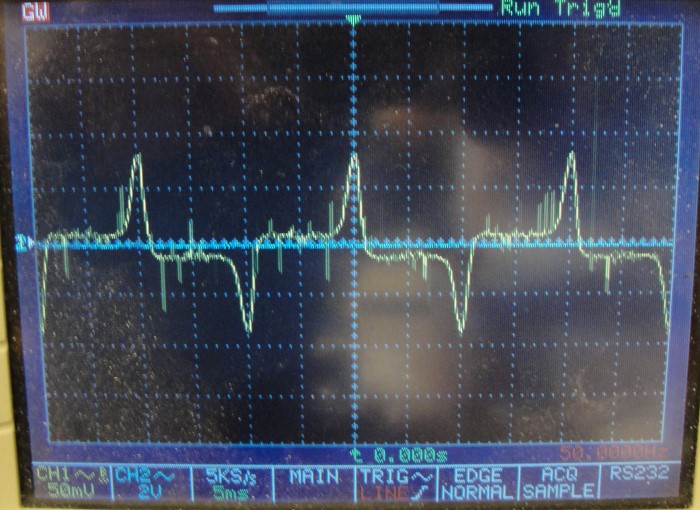 Normal mag current waveform without blocker and no interference (except random noise that is). 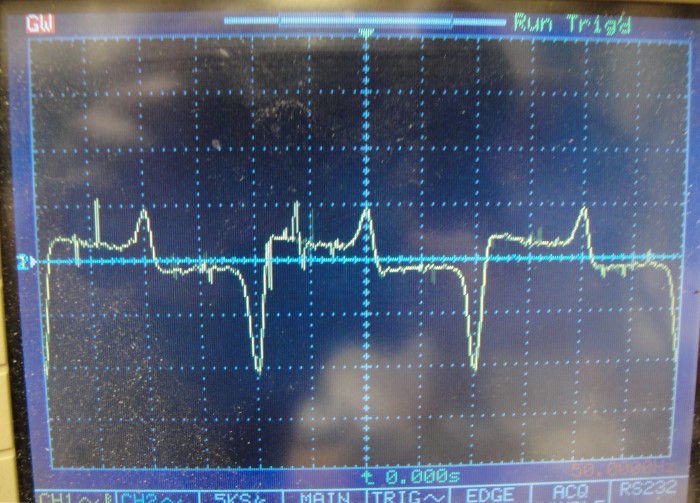 Mag current waveform without blocker with interference source on mains supply. 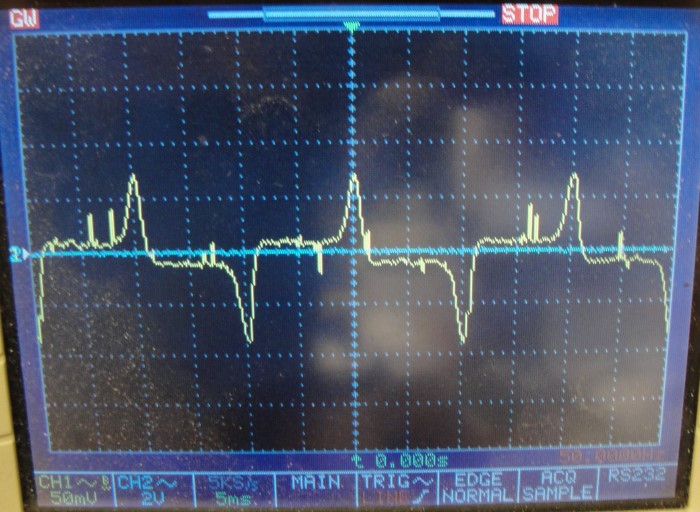 Mag current waveform with blocker and interference source. I pressed the stop button to show the slight one-sidedness which comes and goes with the interference source. Still, quite a good result. Apologies for the mucky 'scope screen. Edited by Graham Slee - 13 Feb 2022 at 7:48pm |
|
|
That none should be able to park up and enjoy the view without a smartphone and the knowledge in how to use apps
|
|
|
|
|
Graham Slee
Admin Group
Retired Joined: 11 Jan 2008 Location: South Yorkshire Status: Offline Points: 16314 |
Post Options
Thanks(0)
Quote Reply
Posted: 18 Feb 2022 at 6:32pm |
|
Making a safer "DC blocker" (or transformer primary current centraliser) Not much room in the amplifier case, so the blocker had to be made compact enough to fit in any spare space away from sensitive parts of the circuit. Using 4,700uF capacitors instead of 10,000uF improves the blocker's response. I chose capacitors rated for 6,000 hours at 105C, with the hope they'll run cooler extending their lifespan to years. I also chose the 25V rating as the ripple current is about 250% larger than the largest expected peak current, for this particular capacitor. The proximity of the rectifiers to the capacitors was a worry in that the rectifiers can dissipate 1.5W each in this application. However, that is at full amplifier power which only ever happens on the test bench when testing for maximum output. Normally the rectifiers will dissipate less than one watt. I decided to attach a thermocouple to monitor the temperature in actual use. The insulation has to provide 100% coverage meaning encapsulating the capacitors in heat shrink tubing. I would not normally recommend this as the safety vent is bunged-up, and if the capacitors were ever to fail and liberate their contents, it would create a very loud bang. However, I am the "Guinee pig" and will test this over a long period. If the temperature is kept well below 105C there should never be a liberation. As it would be contained inside the amplifier case I would venture to say it should be safe.  The best I could imagine to fit the minimum space  Connections soldered (using another short piece of stiff wire through the middle hole to solder the common capacitor ends together either side). The capacitors are insulated with some 3-1 heat shrink tubing with as little heat applied as possible.  The thermocouple held temporarily in place with a rubber band  I made use of an IEC connector insulating boot to cover all the live connections, held in place with a cable tie. This is the finished compact "blocker" ready to be located inside the '70s amp.  And this is the very simple circuit showing the component values used. |
|
|
That none should be able to park up and enjoy the view without a smartphone and the knowledge in how to use apps
|
|
|
|
|
Graham Slee
Admin Group
Retired Joined: 11 Jan 2008 Location: South Yorkshire Status: Offline Points: 16314 |
Post Options
Thanks(0)
Quote Reply
Posted: 18 Feb 2022 at 8:29pm |
|
The compact fully insulated "DC blocker" subjected to maximum amplifier mains supply current for over one hour ranged from 55C to 72C with 72C being recorded with the worst interference, which causes the rectifiers to conduct most of the time. Additional heating came from the amplifier output stage and the transformer, with the case getting unbearably hot, indicating an internal temperature of more than 50C. At 1WPC, however, the "blocker" cooled to 37C. With no interference and no signal, it cooled to 31C. From the above I think it safe to suggest the maximum temperature in normal use could be 55C. The load life of the capacitor, a Rubycon XYG is 6000 hours at 105C at 4.22A ripple. The ripple is rated at 100kHz and also is stated in r.m.s. At 100Hz it is de-rated by 0.7, making it 2.95A. The maximum current in this application is 750mA, and the temperature from above, is 55C. We need a lifetime graph to estimate the lifetime, but none is shown in the data sheet, so I borrowed that data from https://www.farnell.com/datasheets/2244110.pdf which will give a good enough approximation. The actual ripple divided by the rated ripple is 0.75/2.95 = 0.254, and we can see this corresponds to a 15x multiplier. 6000 x 15 = 90,000 hours, which is just over 10 years. |
|
|
That none should be able to park up and enjoy the view without a smartphone and the knowledge in how to use apps
|
|
|
|
|
CageyH
Senior Member
Joined: 30 Apr 2012 Location: Toulouse, Franc Status: Offline Points: 1751 |
Post Options
Thanks(0)
Quote Reply
Posted: 19 Feb 2022 at 10:40am |
|
A more compact version of what I ended up with.
I am happy with the lack of humming traffos now. Does it make a difference to the sound quality? I have no idea…
|
|
|
Kevin
European loan coordinator, based near Toulouse, France. Funkified SL1200 Mk.II, BB3, Firebottle Kin , ADI-2 DAC FS, Modulus 686, PD-S703, Solo UL, Triangle Antal EZ |
|
|
|
|
Post Reply
|
Page <1 2345> |
 Tweet
Tweet
|
| Forum Jump | Forum Permissions You cannot post new topics in this forum You cannot reply to topics in this forum You cannot delete your posts in this forum You cannot edit your posts in this forum You cannot create polls in this forum You cannot vote in polls in this forum |
Forum Software by Web Wiz Forums® version 12.01
Copyright ©2001-2018 Web Wiz Ltd.
This page was generated in 0.070 seconds.
Copyright ©2001-2018 Web Wiz Ltd.
This page was generated in 0.070 seconds.