DC on the mains
Printed From: Graham Slee Hifi System Components
Category: And the rest
Forum Name: Power Sources
Forum Description: Where the power comes from has always been a hot topic - even more so now with new World legislation
URL: https://www.hifisystemcomponents.com/forum/forum_posts.asp?TID=5400
Printed Date: 27 Mar 2026 at 4:02am
Software Version: Web Wiz Forums 12.01 - http://www.webwizforums.com
Topic: DC on the mains
Posted By: CageyH
Subject: DC on the mains
Date Posted: 27 Jan 2022 at 8:39pm
|
The toroidal transformers in my power amp have started to buzz slightly. It is annoying when listening at lower volumes, late at night when my daughter is asleep. The power amp was built as a dual mono, and has two 400VA transformers in it, and 8 x22,000uF capacitors is the power supply section. I have had issues with DC on the mains before, and I have measured it, carefully. It seems to be a thing that occurs more in winter, probably due to more people using electricity for heating purposes. So, I think I need to build myself a DC blocker. There are plenty of circuits available, and even bare PCBs available. The question is, what kind of current capacity should I allow for? With the soft start circuit, I can run my amp with a fuse of about 5 amps, so if I went for 10A, this should give me enough headroom? The fuse rating was calculated using the following: VA/Vmains < Ifuse < 1.5 x VA/Vmains VA/Vmains gives me roughly 3.5A, so 1.5 x VA/Vmains gives me 5.2A, so 5A was chosen. So if I build a DC blocker with 10A constant current capacity, it should be more than adequate? I’ll add a little disclaimer - if you don’t know what you are doing with mains electricity, then don’t mess around with it. It can, and if given a good enough chance, will kill you. ------------- Kevin European loan coordinator, based near Toulouse, France. Funkified SL1200 Mk.II, BB3, Firebottle Kin , ADI-2 DAC FS, Modulus 686, PD-S703, Solo UL, Triangle Antal EZ |
Replies:
Posted By: TimW
Date Posted: 27 Jan 2022 at 9:08pm
|
Kevin, I’ll be interested to know how you get on with your DC blocker. I’ve got a similar buzzing / humming on my Audiolab 8000p. It’s not at an intrusive level and doesn’t affect listening, but I can hear it when the music’s off. Seems to be quieter at some points then louder at others. I’ve seen that ifi Audio and Audiolab have DC blockers available for around the £100 mark. So have considered this. As mentioned the toroid buzz isn’t that loud that I can hear it while listening to music. It’s just that nagging feeling that I know that it’s there. ------------- L*nn LP12, Jelco 750D, AT440MLb / Technics 1200 MKII (Various Carts) / GS Gram Amp 2 SE / Audiolab and Arcam Amplification / Mission 752 Freedom / Dynaudio Audience 42 |
Posted By: CageyH
Date Posted: 27 Jan 2022 at 9:34pm
|
I have seen the IFI one, and don’t know what is inside it. This seems to be the Audiolab one -  Not much in it for £100. A bridge rectifier, and a few caps. Oh, and the certification of a product, and the Audiolab marketing costs. I think I can build two for less that, based on the ATL HiFi PCBs.
------------- Kevin European loan coordinator, based near Toulouse, France. Funkified SL1200 Mk.II, BB3, Firebottle Kin , ADI-2 DAC FS, Modulus 686, PD-S703, Solo UL, Triangle Antal EZ |
Posted By: Fatmangolf
Date Posted: 27 Jan 2022 at 9:37pm
|
If it works and is safe for you, happy listening. ------------- Jon Open mind and ears whilst owning GSP Genera, Accession M, Accession MC, Elevator EXP, Solo ULDE, Proprius amps, Cusat50 cables, Lautus digital cable, Spatia cables and links, and a Majestic DAC. |
Posted By: Graham Slee
Date Posted: 28 Jan 2022 at 8:35am
|
I can assure you that "DC on the mains" is not DC, although it is possible to measure it as such. Toroidal grumbling is due to the transformer's large inrush current as it has to adjust to the received waveform's sudden changes in shape. The cause of this change is often found close to home or in the home. It is a "recent phenomenon" due to energy-efficiency of other mains powered equipment. It is the firing of thyristors in energy-efficient products and one example is the automatic washing machine. If only one half cycle is used, the energy consumed is lower than if the whole cycle is used. It has been noted elsewhere (an electrical engineers forum) that even a half-speed hair dryer is capable of causing a change in mains waveform. Obviously it also depends on the mains wiring impedance, which must be such to allow the sudden "attenuation" to one side of the waveform. Even where an electrical installation has two separate supplies from the meter tails, this waveform change still happens. As such, it might be seen that the electric meter's "shunt resistance" might be all the impedance required. It should then follow that the source of "interference" must be inboard of the electricity meter. How this energy-efficiency affects a toroidal transformer is shown by monitoring its magnetising current. During an event, one side of the magnetising current waveform "disappears" while the other side "grows", and after the event, it returns to be equal for each half cycle. The reason this happens to a toroidal transformer and seldom to any other type, is because toroidal transformers have much lower magnetising current. It can range from units of milliamps, to a few tens of milliamps (about 30mA). Unless the transformer has primary taps to which it is optimised to the local mains, the manufacturer must be careful to ensure it doesn't reach saturation at the highest envisaged supply voltage. The universal 230V EU voltage can have a spread between 207V and 254V. To prevent saturation at 254V the magnetising current at 207V will be only just sufficient, and might be in the order of 5mA or lower. Therefore it is possible that use on a continental 220V supply might result in a worsening of the noise. The rectifier "DC filter" might work to reduce or stop the noise, but doesn't always work. Whether the large can electrolytic capacitors have any effect is debatable. As they are supposed to let AC pass unhindered, and the problem is the AC waveform, then all the rectifier does is drop the voltage by a volt. One large American professional amplifier manufacturer simply used a bridge rectifier without the capacitors. I tried it and it seemed to do much the same. I note that the later models of the amplifiers no longer use them. You can find more on this subject at https://sound-au.com/articles/xfmr-dc.htm - https://sound-au.com/articles/xfmr-dc.htm ------------- That none should be able to park up and enjoy the view without a smartphone and the knowledge in how to use apps |
Posted By: CageyH
Date Posted: 28 Jan 2022 at 8:49am
|
Thanks Graham. The transformers were wound to my local voltage. I am sure it is my heat pump causing the issue, so I put a DC blocker in place yesterday evening (using a 600V 10A bridge rectifier and a couple of 4700uF capacitors) to test, and the hum is gone. I have no issue in the summer, so it ties in that the efficient heat pump is causing the issues by putting all sorts of noise on my mains. Based on this, I will be building a suitable DC Blocker to fit inside my amplifier, as it will be a neater solution than another external box. I have space in the case for something suitable. ------------- Kevin European loan coordinator, based near Toulouse, France. Funkified SL1200 Mk.II, BB3, Firebottle Kin , ADI-2 DAC FS, Modulus 686, PD-S703, Solo UL, Triangle Antal EZ |
Posted By: CageyH
Date Posted: 29 Jan 2022 at 11:04am
|
I have ordered the bits to make my Dc blocker that will fit inside my amplifier. I have the PCB on the way from Sweden, and the diodes and capacitors on the way from the States. Finding somewhere with the diodes and capacitors in stock was a challenge for the parts I wanted. Total cost is about €90 for the parts, but you could do this cheaper. I have gone big on this, probably too big, but this is what the PCB was built for. It has 16 diodes, and 6 capacitors. Apparently, it works well on large toroidal transformers. It should not take long to solder up, but will take a little longer to fit to the amplifier, as I may have to redo the wiring to fit it in the case. I will post more when it is complete. ------------- Kevin European loan coordinator, based near Toulouse, France. Funkified SL1200 Mk.II, BB3, Firebottle Kin , ADI-2 DAC FS, Modulus 686, PD-S703, Solo UL, Triangle Antal EZ |
Posted By: Graham Slee
Date Posted: 29 Jan 2022 at 12:29pm
|
I am following attentively. So I guess that's three filter sections because of the six capacitors, but I'm not sure what the extra four diodes are for. Following the circuit diagram which I assume cannot really differ much from all the others, it is a DC "passer" which drops a total of 6 diode drops in both positive and negative directions. The AC voltage drop would be exactly the same but for the bypass capacitors. By the way, figure 2 from Rod's site shows exactly the behaviour I described earlier, and can illustrate photographically on my 'scope if I have the spare time. It is interesting to see Rod's figure 4 - I shall have to mock that up in the reality of the real world and also photograph it. As Rod says, the plots are almost identical, but I would hazard a guess that the capacitors are adding a teeny weeny bit of phase lag. ------------- That none should be able to park up and enjoy the view without a smartphone and the knowledge in how to use apps |
Posted By: CageyH
Date Posted: 29 Jan 2022 at 1:57pm
|
https://sjostromaudio.com/pages/index.php/hifi-projects/187-dct03-the-dc-trap-high-end-style-heavy-duty - https://sjostromaudio.com/pages/index.php/hifi-projects/187-dct03-the-dc-trap-high-end-style-heavy-duty Detail of the DC blocker is available in the link above. ------------- Kevin European loan coordinator, based near Toulouse, France. Funkified SL1200 Mk.II, BB3, Firebottle Kin , ADI-2 DAC FS, Modulus 686, PD-S703, Solo UL, Triangle Antal EZ |
Posted By: CageyH
Date Posted: 29 Jan 2022 at 1:59pm
|
The schematic is above. The designer references the same text that you linked to earlier. I went for this one based on the feedback on the DIY Audio forum. I am sure it won't be much different from the one I have currently fitted externally.
------------- Kevin European loan coordinator, based near Toulouse, France. Funkified SL1200 Mk.II, BB3, Firebottle Kin , ADI-2 DAC FS, Modulus 686, PD-S703, Solo UL, Triangle Antal EZ |
Posted By: Fatmangolf
Date Posted: 29 Jan 2022 at 5:12pm
|
You have tempted me Kevin. I shall await your findings with interest. ------------- Jon Open mind and ears whilst owning GSP Genera, Accession M, Accession MC, Elevator EXP, Solo ULDE, Proprius amps, Cusat50 cables, Lautus digital cable, Spatia cables and links, and a Majestic DAC. |
Posted By: CageyH
Date Posted: 29 Jan 2022 at 7:51pm
|
Don't forget I am (hopefully) putting this inside my amplifier, so no case is included in the cost. ------------- Kevin European loan coordinator, based near Toulouse, France. Funkified SL1200 Mk.II, BB3, Firebottle Kin , ADI-2 DAC FS, Modulus 686, PD-S703, Solo UL, Triangle Antal EZ |
Posted By: Fatmangolf
Date Posted: 29 Jan 2022 at 9:01pm
|
That is fine with me as I am not averse to lifting the lid to carefully retrofit parts. ------------- Jon Open mind and ears whilst owning GSP Genera, Accession M, Accession MC, Elevator EXP, Solo ULDE, Proprius amps, Cusat50 cables, Lautus digital cable, Spatia cables and links, and a Majestic DAC. |
Posted By: Graham Slee
Date Posted: 29 Jan 2022 at 9:10pm
You did get his written permission? I wouldn't want him to come after the website's owner (me). ------------- That none should be able to park up and enjoy the view without a smartphone and the knowledge in how to use apps |
 CageyH wrote:
Posted By: Graham Slee
Date Posted: 29 Jan 2022 at 9:47pm
Here's my scrap box version for those wishing to save some money.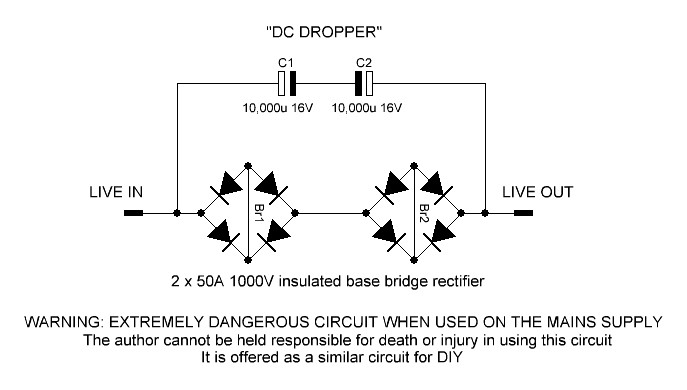 Estimated cost: £10 ex case Be bloody careful! ------------- That none should be able to park up and enjoy the view without a smartphone and the knowledge in how to use apps |
Posted By: CageyH
Date Posted: 29 Jan 2022 at 10:30pm
Nope.So I removed it. It is available on his website for anybody that is interested. ------------- Kevin European loan coordinator, based near Toulouse, France. Funkified SL1200 Mk.II, BB3, Firebottle Kin , ADI-2 DAC FS, Modulus 686, PD-S703, Solo UL, Triangle Antal EZ |
Posted By: Graham Slee
Date Posted: 30 Jan 2022 at 8:27am
Why not put a hyperlink to the image instead? Something in the order of "click here to see the circuit" using the hyperlink tool (^ up there in the reply composer). That would put it in another browser tab and be on his website, and it would still be available for all to see. I know you're well meaning and you put the link in image tags which isn't really uploading but he wouldn't be able to see the HTML. I wouldn't want anybody to think I was pushing my latter circuit contribution - it's just another idea that does the same number of DC stages. ------------- That none should be able to park up and enjoy the view without a smartphone and the knowledge in how to use apps |
Posted By: CageyH
Date Posted: 30 Jan 2022 at 10:06am
|
I have added a link to the owners product info. ------------- Kevin European loan coordinator, based near Toulouse, France. Funkified SL1200 Mk.II, BB3, Firebottle Kin , ADI-2 DAC FS, Modulus 686, PD-S703, Solo UL, Triangle Antal EZ |
Posted By: CageyH
Date Posted: 30 Jan 2022 at 12:00pm
With 50A bridge rectifiers, I assume that some kind of thermal dissipation should be provisioned? Obviously, it won’t be pulling anywhere near 50A, but something like that could happily feed my entire system? ------------- Kevin European loan coordinator, based near Toulouse, France. Funkified SL1200 Mk.II, BB3, Firebottle Kin , ADI-2 DAC FS, Modulus 686, PD-S703, Solo UL, Triangle Antal EZ |
Posted By: CageyH
Date Posted: 30 Jan 2022 at 12:02pm
|
My version that I currently have fitted has a single 10A 600V bridge rectifier, and two 4700uF capacitors, so a little cheaper, but also possibly a little less effective if there is a large “DC element” on the mains. ------------- Kevin European loan coordinator, based near Toulouse, France. Funkified SL1200 Mk.II, BB3, Firebottle Kin , ADI-2 DAC FS, Modulus 686, PD-S703, Solo UL, Triangle Antal EZ |
Posted By: Graham Slee
Date Posted: 30 Jan 2022 at 1:17pm
|
(Replying to the post before last) Not really. There are a few lying about on my R&D bench, and they're overrated for the job, as you say, but they're highly popular for some reason at the moment, so are very inexpensive. I've been using them in my amplifier experiment's power supplies because they're pretty "bomb proof". Apart from switch-on inrush, the primary current to your amplifier's transformers will be less than two amps, with amplifier at full output, so the bridge's won't get hot at all. Mine have a metal base for heatsinking, which is really well insulated from the diode junctions, but even so, I'd insulate them when used on the mains. And the voltage doesn't really matter, as the reverse current flow sees the opposing polarity diodes limit the reverse voltage, and vice versa. The capacitors can be any voltage above say 6V, but 16V is common, and there's nothing to stop the constructor using a higher voltage rating. I think the combined series-parallel rating of what your building at 102,000 uF is a bit OTT. I too have used a couple of 4700uF, but maybe 10,000uF (giving 5000uF because of the series connection) might rid all worry about phase lag. ------------- That none should be able to park up and enjoy the view without a smartphone and the knowledge in how to use apps |
Posted By: CageyH
Date Posted: 31 Jan 2022 at 9:38am
|
I think it is OTT as well, but apparently it works well, and a PCB is easily packaged inside my amp, as the case is huge. The parts I ordered at the end of last week have already been delivered. Just waiting for the PCB now, which I will hope will arrive by the weekend, so I can build and test it, and hopefully find the space and time to install it. ------------- Kevin European loan coordinator, based near Toulouse, France. Funkified SL1200 Mk.II, BB3, Firebottle Kin , ADI-2 DAC FS, Modulus 686, PD-S703, Solo UL, Triangle Antal EZ |
Posted By: CageyH
Date Posted: 05 Feb 2022 at 9:57pm
|
Did I say the PCB was easily packaged in my amp? I lied. So the PCB arrived today, I built it and then tested it as per the instructions provided by the manufacturer. All good, so on to the next phase. Where do I put this in my amp? Oh, easy, at the back where I left some space, except the space was too small. So I had to move the PSU boards a bit, and the soft start a bit, and then I had enough space. So I fitted the board, then checked the connection to earth on the chassis, and to the IEC socket was a nice low resistance reading. Then I connected the DC blocker to the power input, checked polarity and continuity between the connections. All good. Connected the DC blocker to the soft start, and checked continuity of the connections and polarity. All good. Connected up the power cord, and nervously powered on the amp. The amp powered up, no buzzing from the transformers, and more importantly, no magic smoke escaped. It’s a win for me. Would I do it the same way again if I started again? No. The finished board was a pain to fit, and the project, although fun, was more expensive than it needed to be. Anyway, I am happy that my amplifier is running silently. It is the first time for a while. The product works, but so would the circuit that Graham posted. I think it is going to take longer to power down the am now, and I am certainly not going to be putting my hands in the case very quickly after I have removed the power feed with that additional capacitor bank. As always, proceed at you own risk. Mains can, and will kill.
------------- Kevin European loan coordinator, based near Toulouse, France. Funkified SL1200 Mk.II, BB3, Firebottle Kin , ADI-2 DAC FS, Modulus 686, PD-S703, Solo UL, Triangle Antal EZ |
Posted By: Graham Slee
Date Posted: 13 Feb 2022 at 6:44pm
|
I wanted to test the "DC blocker" in the real world, so I built what I drew earlier in this topic, and tested it on the 'scope using my current probe. I used a regular toroidal transformer rated 160VA. I also measured the AC current. It does work, but not as good as claimed. The upper current waveform could be seen to sag ever so slightly. My test interference comes from a Candy auto washer. However, without the "blocker" it sagged considerably more, so it's good? Well, it has to have losses, obviously, and with the "blocker" the mag current read about 15mA, and without it 18mA. These are rough measurements plus or minus a few fractions of a milliamp, but shows there is a loss. My interest in this is for the '70s amp so as to prevent deterioration of sound quality during interference. The SQ is excellent in the dead of night, but not as good when the automatic washer or other daytime things are on. Now, the '70s amp has a high mag current transformer for reasons of regulation, but it is still a toroid - a rather special one the transformer manufacturer has worked hard to develop. It has 80mA mag current, so should not be taken so "one sided" as a regular toroid, but as the SQ depends on this mag current, then a partial collapse, would, I think, worsen the SQ. It will take the total mag current down slightly as demonstrated above, but perhaps only by a few mA, so should be OK. The important thing I think, is waveform symmetry. Does it work? First impressions are it does, but I'm not so easily kidded, and will give it time. I'll do the 'scope shots shortly. ------------- That none should be able to park up and enjoy the view without a smartphone and the knowledge in how to use apps |
Posted By: Graham Slee
Date Posted: 13 Feb 2022 at 7:46pm
|
'Scope shots as promised 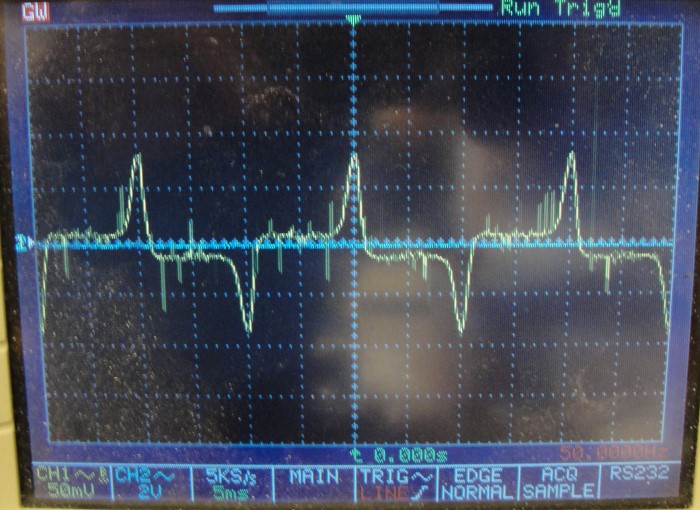 Normal mag current waveform without blocker and no interference (except random noise that is). 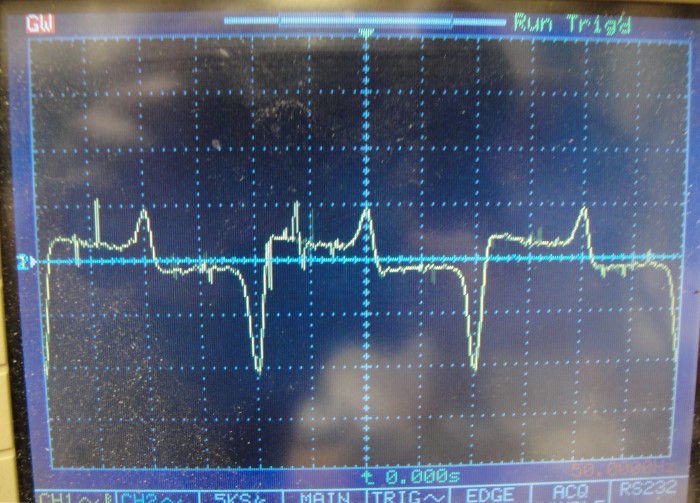 Mag current waveform without blocker with interference source on mains supply. 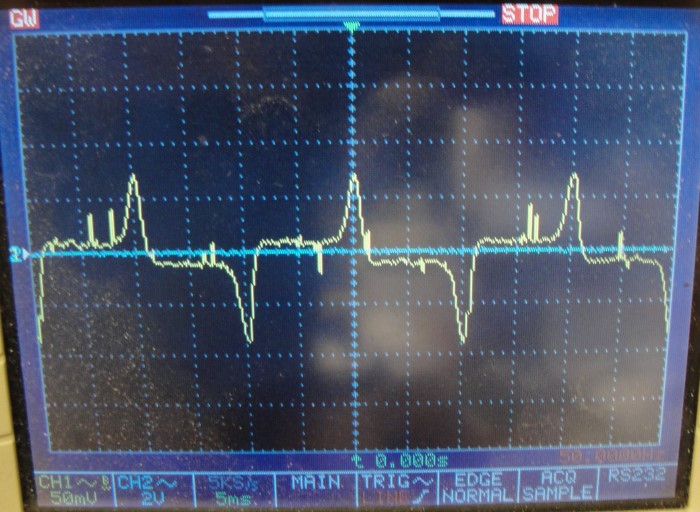 Mag current waveform with blocker and interference source. I pressed the stop button to show the slight one-sidedness which comes and goes with the interference source. Still, quite a good result. Apologies for the mucky 'scope screen. ------------- That none should be able to park up and enjoy the view without a smartphone and the knowledge in how to use apps |
Posted By: Graham Slee
Date Posted: 18 Feb 2022 at 6:32pm
|
Making a safer "DC blocker" (or transformer primary current centraliser) Not much room in the amplifier case, so the blocker had to be made compact enough to fit in any spare space away from sensitive parts of the circuit. Using 4,700uF capacitors instead of 10,000uF improves the blocker's response. I chose capacitors rated for 6,000 hours at 105C, with the hope they'll run cooler extending their lifespan to years. I also chose the 25V rating as the ripple current is about 250% larger than the largest expected peak current, for this particular capacitor. The proximity of the rectifiers to the capacitors was a worry in that the rectifiers can dissipate 1.5W each in this application. However, that is at full amplifier power which only ever happens on the test bench when testing for maximum output. Normally the rectifiers will dissipate less than one watt. I decided to attach a thermocouple to monitor the temperature in actual use. The insulation has to provide 100% coverage meaning encapsulating the capacitors in heat shrink tubing. I would not normally recommend this as the safety vent is bunged-up, and if the capacitors were ever to fail and liberate their contents, it would create a very loud bang. However, I am the "Guinee pig" and will test this over a long period. If the temperature is kept well below 105C there should never be a liberation. As it would be contained inside the amplifier case I would venture to say it should be safe.  The best I could imagine to fit the minimum space  Connections soldered (using another short piece of stiff wire through the middle hole to solder the common capacitor ends together either side). The capacitors are insulated with some 3-1 heat shrink tubing with as little heat applied as possible.  The thermocouple held temporarily in place with a rubber band  I made use of an IEC connector insulating boot to cover all the live connections, held in place with a cable tie. This is the finished compact "blocker" ready to be located inside the '70s amp.  And this is the very simple circuit showing the component values used. ------------- That none should be able to park up and enjoy the view without a smartphone and the knowledge in how to use apps |
Posted By: Graham Slee
Date Posted: 18 Feb 2022 at 8:29pm
|
The compact fully insulated "DC blocker" subjected to maximum amplifier mains supply current for over one hour ranged from 55C to 72C with 72C being recorded with the worst interference, which causes the rectifiers to conduct most of the time. Additional heating came from the amplifier output stage and the transformer, with the case getting unbearably hot, indicating an internal temperature of more than 50C. At 1WPC, however, the "blocker" cooled to 37C. With no interference and no signal, it cooled to 31C. From the above I think it safe to suggest the maximum temperature in normal use could be 55C. The load life of the capacitor, a Rubycon XYG is 6000 hours at 105C at 4.22A ripple. The ripple is rated at 100kHz and also is stated in r.m.s. At 100Hz it is de-rated by 0.7, making it 2.95A. The maximum current in this application is 750mA, and the temperature from above, is 55C. We need a lifetime graph to estimate the lifetime, but none is shown in the data sheet, so I borrowed that data from https://www.farnell.com/datasheets/2244110.pdf - https://www.farnell.com/datasheets/2244110.pdf which will give a good enough approximation. The actual ripple divided by the rated ripple is 0.75/2.95 = 0.254, and we can see this corresponds to a 15x multiplier. 6000 x 15 = 90,000 hours, which is just over 10 years. ------------- That none should be able to park up and enjoy the view without a smartphone and the knowledge in how to use apps |
Posted By: CageyH
Date Posted: 19 Feb 2022 at 10:40am
|
A more compact version of what I ended up with. I am happy with the lack of humming traffos now. Does it make a difference to the sound quality? I have no idea… ------------- Kevin European loan coordinator, based near Toulouse, France. Funkified SL1200 Mk.II, BB3, Firebottle Kin , ADI-2 DAC FS, Modulus 686, PD-S703, Solo UL, Triangle Antal EZ |
Posted By: Graham Slee
Date Posted: 19 Feb 2022 at 11:41am
I think it does, but "downunder friend" doesn't quite see things my way, and so I tend to keep my mouth shut, but this time it's different. It is difficult to "see" the workings of this, yes, even for me, but something that would otherwise steal transformer magnetising current each half cycle, isn't going to be much good for the amplifier it's powering. By "centering" the waveform, then the relationship of mag current to reservoir capacitor charging current becomes "even". OK, the reservoir charging current is per every 100Hz (120Hz elsewhere) and the musical waveform is everywhere else, and the current drawn each conduction angle is not the mag current, which occurs at a different angle within the 180 degrees, but DC is not DC in the strictest sense. All analogue amplifiers are cap coupled as "downunder friend" does actually say, yes, even the DC coupled amps are cap coupled, because the current into the reservoirs only conducts for part of the mains cycle. At all other times they are supplying energy all by themselves. So if the signal demands current (which it does) and the mag current is offset, then it's out of balance compared to the next 10mS. The relationship to mag current is due to the non-linear capacitive filter rectifier load, and transformer winding harmonics, which can increase the mag current, unless it isn't there because of interference. So basically, the naysayers say it can have no effect. That depends on whether you over analyse things like I do, or you deny that little things have any effect. It used to be said that if you look after all the little things, then big things would follow. Perhaps I'm old fashioned in that respect. Anyway, the 1W distortion fell from 0.009% to 0.007% so something about it works. ------------- That none should be able to park up and enjoy the view without a smartphone and the knowledge in how to use apps |
Posted By: Graham Slee
Date Posted: 19 Feb 2022 at 11:50am
Or even the reduction in noise. ------------- That none should be able to park up and enjoy the view without a smartphone and the knowledge in how to use apps |
Posted By: CageyH
Date Posted: 19 Feb 2022 at 1:07pm
|
I am a great believer in “every little helps”. My amplifier is based on the LM3886, and apparently has the following specs: Output power: 360 W (4 Ω) – 240 W (8 Ω). Ultra-low 0.00026 % THD+N (140 W, 8 Ω, 1 kHz). Ultra-low 0.00048 % THD+N (100 W, 4 Ω, 1 kHz).
------------- Kevin European loan coordinator, based near Toulouse, France. Funkified SL1200 Mk.II, BB3, Firebottle Kin , ADI-2 DAC FS, Modulus 686, PD-S703, Solo UL, Triangle Antal EZ |
Posted By: Graham Slee
Date Posted: 19 Feb 2022 at 1:45pm
|
With that amount of NFB - about 30dB available at 20kHz for a voltage gain of 20 - then distortion and noise simply vanishes (fig.47 LM3886 datasheet). The point though is what it does within the first watt, where most of the detailed listening takes place. No matter how good a circuit is, external factors can be more prominent. Not that a power supply should be considered an external factor, but is often considered that way. ------------- That none should be able to park up and enjoy the view without a smartphone and the knowledge in how to use apps |