


 Topic Options
Copyright © 1998
Cadman Enterprises Ltd

Welcome to the Graham Slee Audio Products Owners Forum  Open to all owners plus those contemplating the purchase of a Graham Slee HiFi System Components audio product and wishing to use this forum's loaner program: join here (Rules on posting can be found here) This website along with trade marks Graham Slee and HiFi System Components are owned by Cadman Enterprises Ltd |
Aria Line-Stage |
Post Reply 
|
Page <1234 8> |
| Author | |
Graham Slee 
Admin Group 

Retired Joined: 11 Jan 2008 Location: South Yorkshire Status: Offline Points: 16314 |
 Post Options Post Options
 Thanks(0) Thanks(0)
 Quote Reply Quote Reply
 Posted: 20 Sep 2011 at 10:10pm Posted: 20 Sep 2011 at 10:10pm |
|
The tone control may now have to be another box..........
how many power supplies and adapters?   Reason: public demand wants more than just bass and treble. [edit] but let me have a look into it - I may be able to squeeze one in...  Edited by Graham Slee - 21 Sep 2011 at 9:58am |
|
|
That none should be able to park up and enjoy the view without a smartphone and the knowledge in how to use apps
|
|
 |
|
|
Graham Slee
Admin Group
Retired Joined: 11 Jan 2008 Location: South Yorkshire Status: Offline Points: 16314 |
Post Options
Thanks(0)
Quote Reply
Posted: 11 Oct 2011 at 10:16pm |
|
Much research since last post. Space limitations for this mighty atom mean the tone control won't fit so we'll have to do that as an accessory. The Alps RK271 motorized pot takes up too much room. We have the option of a smaller Alps motorized pot if the European supplier would only provide a sample (we asked for one and await its arrival). The minimum order quantity is 400 pieces which is an expensive way to find out if it's any good. If it leaves more room then we'll look into doing the see-saw bass/treble control a few of you asked for.
This is hopefully the last lash-up before we commit the design to a PCB... 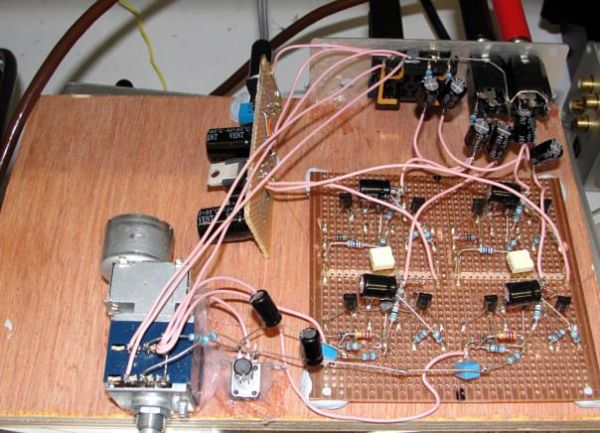 It uses a variation of JL Hood's class-A transistor triple more akin to the output stage of the great NE5534 classic audio op-amp, and with strong similarities to the gain-clone output stage. Unlike op-amps which deliver class-B current, this discrete BJT design runs with 10mA quiescent current per stage and is therefore able to drive its full output into a 1k Ohm load without leaving the class-A bias envelope. It has near 90 degree phase margin and a massive gain margin for stability under all expected loads. An earlier test stage measured 0.015% THD+N (distortion) and better than -85dB noise (CCIR quasi peak 22Kz - 22kHz ... A wtd. it will be nearer -95dB). There are two stages per channel. They are inverting stages with the first providing all the gain and the anti-phase side of the balanced output, while the second stage re-inverts the signal to give the in-phase side of the balanced output and also the single ended output. There is also a stereo balance control. Input selection has not yet been prototyped but should be a matter of course being the passive section. The space to the left will shortly be occupied by the remote control receiver/decoder board. Edited by Graham Slee - 11 Oct 2011 at 11:04pm |
|
|
That none should be able to park up and enjoy the view without a smartphone and the knowledge in how to use apps
|
|
|
|
|
Cyreg
Moderator Group 

Joined: 15 Jan 2008 Location: Netherlands Status: Offline Points: 316 |
Post Options
Thanks(0)
Quote Reply
Posted: 13 Oct 2011 at 8:12pm |
|
Graham, any professional assessment of how it sounds atm
No UL device   in this design neccesary for tubelike sound in this design neccesary for tubelike sound
Very curious about the sound
 But is it going to be specially trimmed for Proprius or more general/allround specs/sound?
|
|
|
TecnoDec/RB250/MP110>GramAmp2C/PSU1; Cyrus CD8SE; > Exposure 3010S2D INT > Harbeth C7ES-3 '35th Anniversary'
cabling: IC 2x DNM V3; LScable Exposure DMF-two; Furu TP60 + MWaY and BlackCable pc's |
|
|
|
|
Graham Slee
Admin Group
Retired Joined: 11 Jan 2008 Location: South Yorkshire Status: Offline Points: 16314 |
Post Options
Thanks(1)
Quote Reply
Posted: 13 Oct 2011 at 9:36pm |
|
Cyreg,
Is this UL? Yes! It is the very epitome of ultra-linear. It is just that the technique is supplied in a different configuration, but the technique still pays off. Let's restate what IMO ultra-linear is: 1] linear input (or as close as possible); 2] wide bandwidth open loop gain; 3] the smallest amount of negative feedback to result in acceptable distortion and noise - in our case we consider that to be less than 0.05%THD and for a line stage preamp better than -80dB noise; 4] similar distortion at all frequencies - usually THD grows with increasing frequency; 5] class-A wherever possible (class AB acceptable for a power amp provided the bias is sufficient to null out to the lowest THD reading); 6] Good phase and gain margins for high frequency stability... This is achieved in all our ultra-linear adaptations. Sound? Try cheating a Harbeth M20. Since these things have run in they tell me immediately if I got anything wrong. More so than anything else I have used to monitor with. Near-field they are so unforgiving. The lash-up pictured above is being thrashed to reveal all and will be suitably tweaked as and where necessary over the next few weeks. At first switch on, and as is usual for us, it lacked much. But after 48 hours it is starting to do its (dare I say) magic. We developed the Proprius to be as transparent as possible because we felt we would exhaust ourselves and use up valuable time (and lots of cash) trying other power amplifiers. We have not yet committed the Proprius to final design because we have detected a SQ issue through the M20 we'd not picked out on other speakers. You can be assured that with our many years of experience that none of these products skew the sound toward one signature or another and as such will work independently in other systems but will contribute to each other when used together. As I grow older I take much more time over the finest details - I never want our designs to be the subject of blame. They must impress in every area for a very long lifetime and must be ambassadors of correctness. And yes, they must sound tube like as the very best of tube designs of which I believe there are very few on the market today. I would say Adrian's aging tubed Dansette record player could give many tube designs of today the run around. The best sounding tube designs I ever heard were used in theatre and cinema. |
|
|
That none should be able to park up and enjoy the view without a smartphone and the knowledge in how to use apps
|
|
|
|
|
Graham Slee
Admin Group
Retired Joined: 11 Jan 2008 Location: South Yorkshire Status: Offline Points: 16314 |
Post Options
Thanks(0)
Quote Reply
Posted: 13 Dec 2011 at 9:17pm |
|
Further developments you may find interesting?
The active stages are now very sonically acceptable. You may note that it's not discrete anymore. Why? The reason was that no matter which discrete configuration was used, it didn't return a specification performance I felt would appeal to a majority of would-be customers. There are discrete transistor configurations capable of such specifications but they are far from linear in an open-loop condition, which kind of destroys the intention. Therefore it's been "keyhole surgery" time with an op-amp having an output stage that's the most musical I ever heard, but whose input is only sufficiently linear in its inverting mode. That's not a problem here as I need a double inversion to provide the phase and anti-phase signals for the balanced outputs, so both sections are inverting and hence very linear. The "keyhole surgery" took care of the remaining ultra-linear requirement of very much wider open loop frequency response - more than the audio spectrum! Here's a photo of the "rats-nest" breadboard which got a little more complicated with the addition of an output relay circuit to protect against naughty switch on and switch off noises. Such a board is dead simple if you have an inbuilt a.c. supply but as this is ran off a DC supply (PSU1) it's a bit more of a challenge, and the output relays have to be operated either on mains-fail or if someone unplugs/re-plugs the DC. Believe it or not, in this messy form it works, it measures great and it sounds sublime. 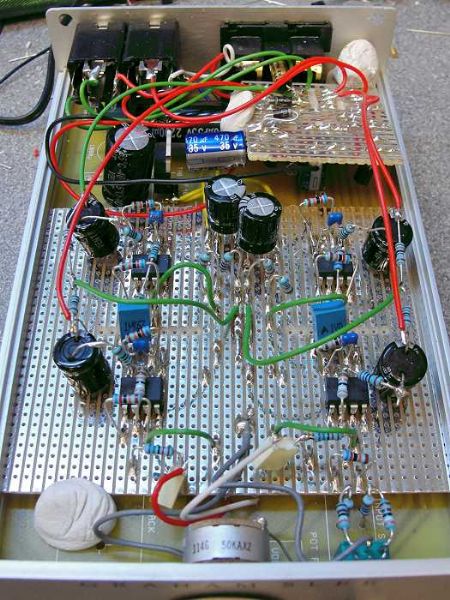 The next photo shows the remote control evaluation board strapped on top of the prototype Aria with an insulating block and masking tape - "appropriate technology" for evaluation purposes. The infra red parts are missing at this point in time - this stage is to test that the encoder and decoder are communicating which they are. 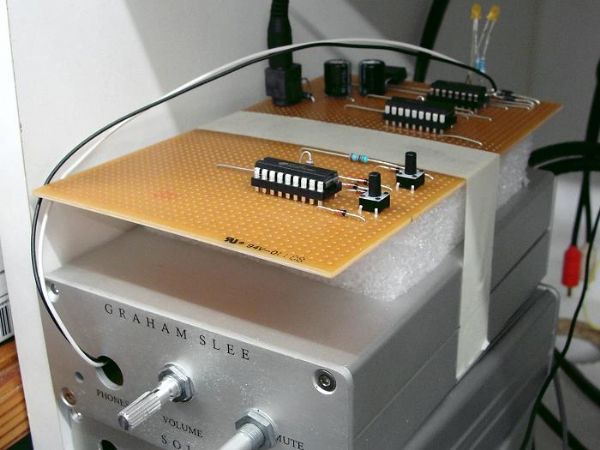 The furthest section comprises two chips and is the receiver section which will be inside the preamp (we may offer a manual version with the receiver missing if there is a demand). The nearest section is the transmitter. Both sections can be easily shrunk down to the appropriate sizes. The remote control is a very simple and unique one designed to ensure there's no interference between it and any other remote controls. And just in case somebody else stumbles on this idea we can easily change the addresses. |
|
|
That none should be able to park up and enjoy the view without a smartphone and the knowledge in how to use apps
|
|
|
|
|
Graham Slee
Admin Group
Retired Joined: 11 Jan 2008 Location: South Yorkshire Status: Offline Points: 16314 |
Post Options
Thanks(1)
Quote Reply
Posted: 30 Dec 2011 at 2:53pm |
|
Latest update:
Remote Control working! The remote control is a proprietary in-house design. The simplest implementation I've been able to think up, it runs in "hardware" rather than "software" simply because the learning curve in software is too much for my "grey cells" right now. I guess the functions could be put on a programmable IC (PIC) but that would only save one IC and whilst ever there's the appropriate chips on sale, I'd rather put my time toward SQ than showing off. The designs lend themselves to considerable miniaturisation so don't worry about the remote being the size of a brick. It will be remote control size! 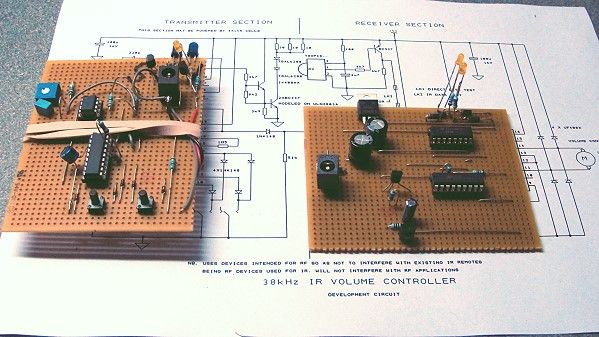 The development board now separated into transmit and receive sections. Transmit board on left. Receiver board on right. 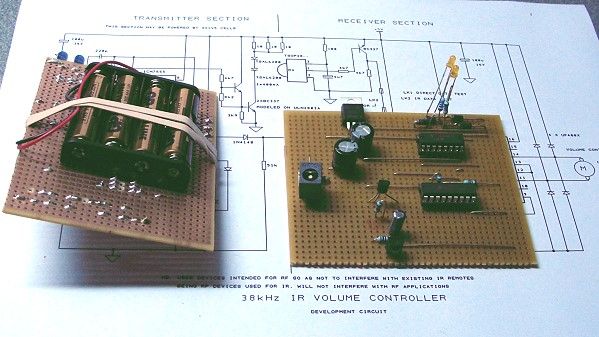 And another photo showing the transmitter battery holder (4 x AAA cells). So how well does it work? I placed the receiver on a shelf in the back room, and from the filing cabinet 6 metres away no hesitation. Aiming the transmitter 90 degrees off axis... still worked. Aiming at ceiling... still worked. Aiming in the opposite direction... still worked. Aiming at the floor under my desk... didn't work, but that was asking for a miracle anyway. To find out the actual range would mean testing it outdoors but as it's raining.... With just about everything tested and working it's PCB and case design time... stay tuned! |
|
|
That none should be able to park up and enjoy the view without a smartphone and the knowledge in how to use apps
|
|
|
|
|
less
Senior Member 

Joined: 27 May 2008 Location: Clevedon Status: Offline Points: 334 |
Post Options
Thanks(0)
Quote Reply
Posted: 18 Jul 2012 at 1:44pm |
|
Hi Graham,
have you established a price point for the Aria yet? As your last post on this topic was over six months ago can we assume that the finished product is very near? Regards Les
|
|
|
I don't do mediocrity!
Les Sutherland |
|
|
|
|
Post Reply
|
Page <1234 8> |
 Tweet
Tweet
|
| Forum Jump | Forum Permissions You cannot post new topics in this forum You cannot reply to topics in this forum You cannot delete your posts in this forum You cannot edit your posts in this forum You cannot create polls in this forum You cannot vote in polls in this forum |
Forum Software by Web Wiz Forums® version 12.01
Copyright ©2001-2018 Web Wiz Ltd.
This page was generated in 0.063 seconds.
Copyright ©2001-2018 Web Wiz Ltd.
This page was generated in 0.063 seconds.