Aria Line-Stage
Printed From: Graham Slee Hifi System Components
Category: And the rest
Forum Name: Amplification
Forum Description: Share your interests or views on amplifiers, preamps, etc
URL: https://www.hifisystemcomponents.com/forum/forum_posts.asp?TID=1193
Printed Date: 27 Mar 2026 at 12:35am
Software Version: Web Wiz Forums 12.01 - http://www.webwizforums.com
Topic: Aria Line-Stage
Posted By: Graham Slee
Subject: Aria Line-Stage
Date Posted: 19 Sep 2011 at 8:27pm
|
A short history so far: Started back in 2009, the Aria Line Stage was shelved because of the lack of facilities to properly audition it here. Since then we had the new workshop built (2010) which has sufficient space (only just) to be able to audition using speakers. However, we didn't have the right amplification or speakers. Since the start of 2011 the Proprius twin monoblocs have been developed (now being productionized) and we have two sets of speakers, completing a system that's mercilessly revealing. To remote control or not? Initially, the Aria, a "desktop" line preamp stage, one of its uses being desk top, was not going to have remote volume control. However, "the trade" didn't like that. So over the past few weeks I've been researching remote control. I have looked at both solid state and semi-mechanical solutions. The solid state solutions include a number of types of transconductance "op-amps", either encapsulated "discrete" or integrated on one chip. The transconductance devices vary from lo-fi to studio console quality. All of them require a considerable amount of logic and precision integrators to function correctly. Forget optical volume control along the lines of the "Lightspeed" or similar: RoHS (now virtually world-wide) forbids light dependent resistor usage because the substances used are classed as hazardous, and, 5 years since RoHS came in, no manufacturer has come up with a non-hazardous solution. The semi-mechanical solution is basically a motor driven (wait for it!...) Alps RK271 dual potentiometer (hyped up as being "blue velvet" or "blue beauty"). That's the easy bit. The remote transmitter and receiver is a bit more difficult but not beyond me. Separate power supplies? The problem in using a motor driven pot, and the remote control circuit itself, is interference, and that's why I didn't want one in the first place! However, needs must, so we're looking at a circuit that's going to draw near on 200 mA (0.2 Amps) average just to save us getting off the settee... (the Alps pot uses between 100 and 150mA. The decoder and logic getting close on 100mA) That is 200 mA of "dirty current" you don't want mixing up with the audio power supply current. I don't like having the power supply in the stage so I do external power supplies. Due to different countries having different rules, to make it possible to sell our products world-wide, we stick to one of two approved power supplies: the PSU1 and the switchmode ("green" - now a silenced version). The only way we can power the remote control is off a separate power supply to the audio one (either a PSU1 or "green"), so the Aria will end up having two power supplies: one for the audio and one for the remote. At least the purist will easily be able to disable the remote control completely, simply by not using its power supply. I trust would-be purchasers would be happy with this? We will be including the Aria (and Proprius) in the loaner program. ------------- That none should be able to park up and enjoy the view without a smartphone and the knowledge in how to use apps |
Replies:
Posted By: tg [RIP]
Date Posted: 19 Sep 2011 at 9:54pm
|
I assume from reading this that the motorised pot would also have a knob and with its motor drive not powered on would still be usable as a manual control ? |
Posted By: Graham Slee
Date Posted: 19 Sep 2011 at 11:21pm
Quite correct. It would conceivably also be possible to completely remove the remote control board and replace the motorised pot with a non-motorised pot. ------------- That none should be able to park up and enjoy the view without a smartphone and the knowledge in how to use apps |
 tg wrote:
Posted By: mrarroyo
Date Posted: 19 Sep 2011 at 11:36pm
|
We have become very lazy in the 21st century. I have an inkling many will use the remote volume pot.
------------- Miguel |
Posted By: Cyreg
Date Posted: 20 Sep 2011 at 1:45pm
I do use an LFD MkIII amplifier > no remote > purity of design (take a look inside)  . .
Feels a little like GSP gear with smart design, a lot of listening and matching the right components.
http://www.hifi.nl/gfx/LFD_zero_III_8.jpg" rel="nofollow - http://www.hifi.nl/gfx/LFD_zero_III_8.jpg
If you play LP's you're at the TT setup/volumecontrol every 20 minutes at least anyway, so....
OK, I had to get used to that too, after my remote "all controlling" Cyrus gear.
Perhaps both options would be best (surely differently priced!) to see
 ------------- TecnoDec/RB250/MP110>GramAmp2C/PSU1; Cyrus CD8SE; > Exposure 3010S2D INT > Harbeth C7ES-3 '35th Anniversary' cabling: IC 2x DNM V3; LScable Exposure DMF-two; Furu TP60 + MWaY and BlackCable pc's |
Posted By: Graham Slee
Date Posted: 20 Sep 2011 at 4:27pm
Yes, I agree. It ought to be an optional extra and thus doing without the remote should cost less. ------------- That none should be able to park up and enjoy the view without a smartphone and the knowledge in how to use apps |
Posted By: Fatmangolf
Date Posted: 20 Sep 2011 at 8:57pm
|
Hi Graham (and everyone else!), I remember reading about the tone control you had developed for this and being very interested. I hadn't considered the volume control aspect but would agree with pay more for the RC if that helps.
------------- Jon Open mind and ears whilst owning GSP Genera, Accession M, Accession MC, Elevator EXP, Solo ULDE, Proprius amps, Cusat50 cables, Lautus digital cable, Spatia cables and links, and a Majestic DAC. |
Posted By: Graham Slee
Date Posted: 20 Sep 2011 at 10:10pm
|
The tone control may now have to be another box.......... how many power supplies and adapters?   Reason: public demand wants more than just bass and treble. [edit] but let me have a look into it - I may be able to squeeze one in...  ------------- That none should be able to park up and enjoy the view without a smartphone and the knowledge in how to use apps |
Posted By: Graham Slee
Date Posted: 11 Oct 2011 at 10:16pm
|
Much research since last post. Space limitations for this mighty atom mean the tone control won't fit so we'll have to do that as an accessory. The Alps RK271 motorized pot takes up too much room. We have the option of a smaller Alps motorized pot if the European supplier would only provide a sample (we asked for one and await its arrival). The minimum order quantity is 400 pieces which is an expensive way to find out if it's any good. If it leaves more room then we'll look into doing the see-saw bass/treble control a few of you asked for. This is hopefully the last lash-up before we commit the design to a PCB... 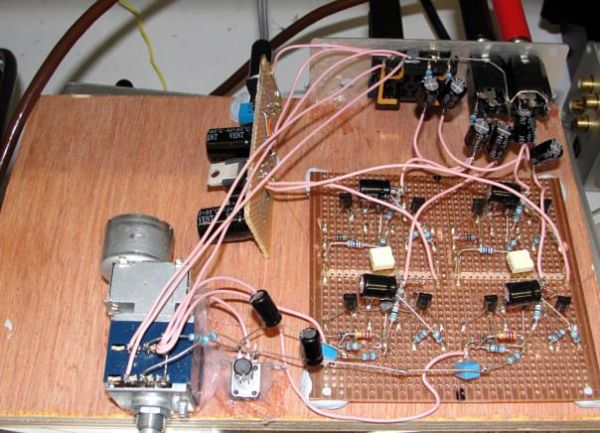 It uses a variation of JL Hood's class-A transistor triple more akin to the output stage of the great NE5534 classic audio op-amp, and with strong similarities to the gain-clone output stage. Unlike op-amps which deliver class-B current, this discrete BJT design runs with 10mA quiescent current per stage and is therefore able to drive its full output into a 1k Ohm load without leaving the class-A bias envelope. It has near 90 degree phase margin and a massive gain margin for stability under all expected loads. An earlier test stage measured 0.015% THD+N (distortion) and better than -85dB noise (CCIR quasi peak 22Kz - 22kHz ... A wtd. it will be nearer -95dB). There are two stages per channel. They are inverting stages with the first providing all the gain and the anti-phase side of the balanced output, while the second stage re-inverts the signal to give the in-phase side of the balanced output and also the single ended output. There is also a stereo balance control. Input selection has not yet been prototyped but should be a matter of course being the passive section. The space to the left will shortly be occupied by the remote control receiver/decoder board. ------------- That none should be able to park up and enjoy the view without a smartphone and the knowledge in how to use apps |
Posted By: Cyreg
Date Posted: 13 Oct 2011 at 8:12pm
|
Graham, any professional assessment of how it sounds atm
No UL device  in this design neccesary for tubelike sound in this design neccesary for tubelike sound
Very curious about the sound
 But is it going to be specially trimmed for Proprius or more general/allround specs/sound? ------------- TecnoDec/RB250/MP110>GramAmp2C/PSU1; Cyrus CD8SE; > Exposure 3010S2D INT > Harbeth C7ES-3 '35th Anniversary' cabling: IC 2x DNM V3; LScable Exposure DMF-two; Furu TP60 + MWaY and BlackCable pc's |
Posted By: Graham Slee
Date Posted: 13 Oct 2011 at 9:36pm
|
Cyreg, Is this UL? Yes! It is the very epitome of ultra-linear. It is just that the technique is supplied in a different configuration, but the technique still pays off. Let's restate what IMO ultra-linear is: 1] linear input (or as close as possible); 2] wide bandwidth open loop gain; 3] the smallest amount of negative feedback to result in acceptable distortion and noise - in our case we consider that to be less than 0.05%THD and for a line stage preamp better than -80dB noise; 4] similar distortion at all frequencies - usually THD grows with increasing frequency; 5] class-A wherever possible (class AB acceptable for a power amp provided the bias is sufficient to null out to the lowest THD reading); 6] Good phase and gain margins for high frequency stability... This is achieved in all our ultra-linear adaptations. Sound? Try cheating a Harbeth M20. Since these things have run in they tell me immediately if I got anything wrong. More so than anything else I have used to monitor with. Near-field they are so unforgiving. The lash-up pictured above is being thrashed to reveal all and will be suitably tweaked as and where necessary over the next few weeks. At first switch on, and as is usual for us, it lacked much. But after 48 hours it is starting to do its (dare I say) magic. We developed the Proprius to be as transparent as possible because we felt we would exhaust ourselves and use up valuable time (and lots of cash) trying other power amplifiers. We have not yet committed the Proprius to final design because we have detected a SQ issue through the M20 we'd not picked out on other speakers. You can be assured that with our many years of experience that none of these products skew the sound toward one signature or another and as such will work independently in other systems but will contribute to each other when used together. As I grow older I take much more time over the finest details - I never want our designs to be the subject of blame. They must impress in every area for a very long lifetime and must be ambassadors of correctness. And yes, they must sound tube like as the very best of tube designs of which I believe there are very few on the market today. I would say Adrian's aging tubed Dansette record player could give many tube designs of today the run around. The best sounding tube designs I ever heard were used in theatre and cinema. ------------- That none should be able to park up and enjoy the view without a smartphone and the knowledge in how to use apps |
Posted By: Graham Slee
Date Posted: 13 Dec 2011 at 9:17pm
|
Further developments you may find interesting? The active stages are now very sonically acceptable. You may note that it's not discrete anymore. Why? The reason was that no matter which discrete configuration was used, it didn't return a specification performance I felt would appeal to a majority of would-be customers. There are discrete transistor configurations capable of such specifications but they are far from linear in an open-loop condition, which kind of destroys the intention. Therefore it's been "keyhole surgery" time with an op-amp having an output stage that's the most musical I ever heard, but whose input is only sufficiently linear in its inverting mode. That's not a problem here as I need a double inversion to provide the phase and anti-phase signals for the balanced outputs, so both sections are inverting and hence very linear. The "keyhole surgery" took care of the remaining ultra-linear requirement of very much wider open loop frequency response - more than the audio spectrum! Here's a photo of the "rats-nest" breadboard which got a little more complicated with the addition of an output relay circuit to protect against naughty switch on and switch off noises. Such a board is dead simple if you have an inbuilt a.c. supply but as this is ran off a DC supply (PSU1) it's a bit more of a challenge, and the output relays have to be operated either on mains-fail or if someone unplugs/re-plugs the DC. Believe it or not, in this messy form it works, it measures great and it sounds sublime. 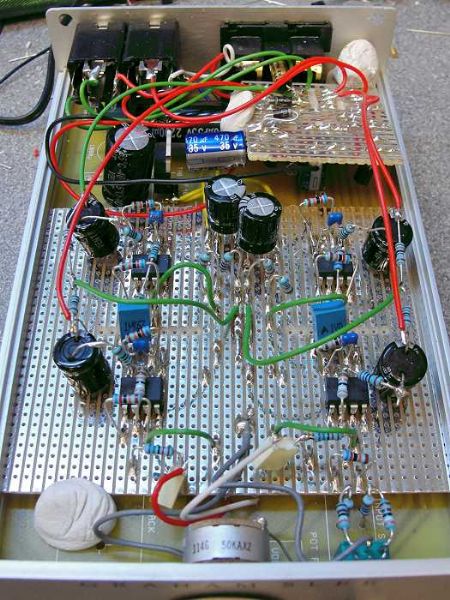 The next photo shows the remote control evaluation board strapped on top of the prototype Aria with an insulating block and masking tape - "appropriate technology" for evaluation purposes. The infra red parts are missing at this point in time - this stage is to test that the encoder and decoder are communicating which they are. 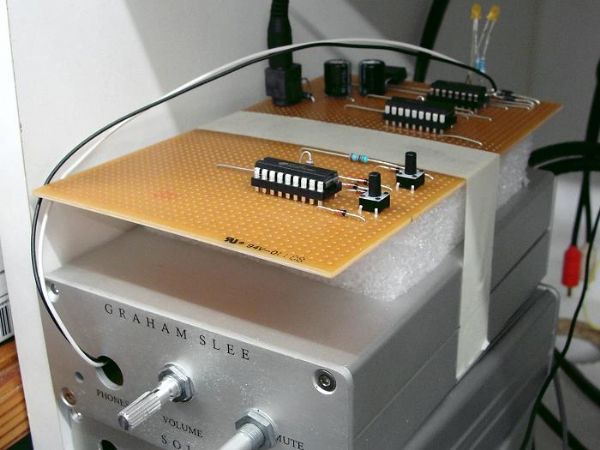 The furthest section comprises two chips and is the receiver section which will be inside the preamp (we may offer a manual version with the receiver missing if there is a demand). The nearest section is the transmitter. Both sections can be easily shrunk down to the appropriate sizes. The remote control is a very simple and unique one designed to ensure there's no interference between it and any other remote controls. And just in case somebody else stumbles on this idea we can easily change the addresses. ------------- That none should be able to park up and enjoy the view without a smartphone and the knowledge in how to use apps |
Posted By: Graham Slee
Date Posted: 30 Dec 2011 at 2:53pm
|
Latest update: Remote Control working! The remote control is a proprietary in-house design. The simplest implementation I've been able to think up, it runs in "hardware" rather than "software" simply because the learning curve in software is too much for my "grey cells" right now. I guess the functions could be put on a programmable IC (PIC) but that would only save one IC and whilst ever there's the appropriate chips on sale, I'd rather put my time toward SQ than showing off. The designs lend themselves to considerable miniaturisation so don't worry about the remote being the size of a brick. It will be remote control size! 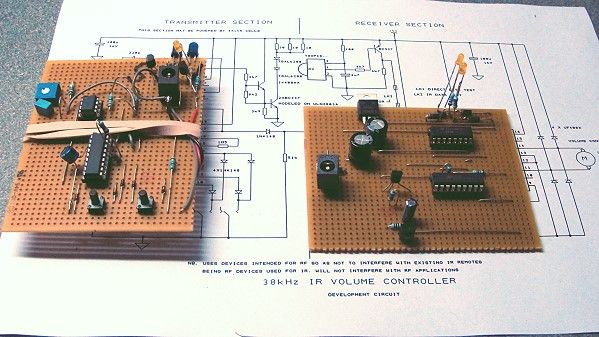 The development board now separated into transmit and receive sections. Transmit board on left. Receiver board on right. 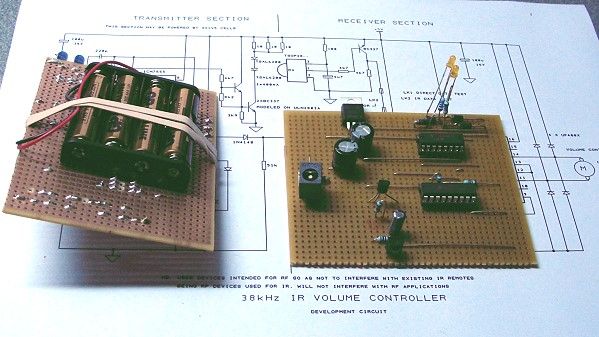 And another photo showing the transmitter battery holder (4 x AAA cells). So how well does it work? I placed the receiver on a shelf in the back room, and from the filing cabinet 6 metres away no hesitation. Aiming the transmitter 90 degrees off axis... still worked. Aiming at ceiling... still worked. Aiming in the opposite direction... still worked. Aiming at the floor under my desk... didn't work, but that was asking for a miracle anyway. To find out the actual range would mean testing it outdoors but as it's raining.... With just about everything tested and working it's PCB and case design time... stay tuned! ------------- That none should be able to park up and enjoy the view without a smartphone and the knowledge in how to use apps |
Posted By: less
Date Posted: 18 Jul 2012 at 1:44pm
|
Hi Graham, have you established a price point for the Aria yet? As your last post on this topic was over six months ago can we assume that the finished product is very near? Regards Les ------------- I don't do mediocrity! Les Sutherland |
Posted By: Humboldt
Date Posted: 13 Dec 2012 at 10:17am
| Is this project still alive? Any idea when the line stage could be ready for production? |
Posted By: Graham Slee
Date Posted: 13 Dec 2012 at 11:08am
|
Yes, well and truly still alive. Much hinges on the quality of the balanced line outputs and here I have not been satisfied with any of the electronic balanced configurations in existence. The preamp must appear "invisible" to the music and nothing does it the way I want and that search has taken around 3 years so far. I am currently looking into transformer balancing but that may not be the answer either. There will be a way but unfortunately the depth of study this standard of performance requires is very time consuming. ------------- That none should be able to park up and enjoy the view without a smartphone and the knowledge in how to use apps |
Posted By: BackinBlack
Date Posted: 13 Dec 2012 at 2:10pm
| Very glad to hear that the Aria is progressing. Sorry to hear that balanced Audio Nirvana is proving elusive! Hopefully there will be a Eureka moment. |
Posted By: less
Date Posted: 17 Dec 2012 at 9:48am
All good things come to those who wait! However, I do agree that the waiting is always the hardest part. Suffice in the knowledge that Graham is driven by the desire to "get it right" and not by the whims and demands of a marketing department whose product knowledge is almost zero. When the Aria is available bags me the first one of the production line! Les.  ------------- I don't do mediocrity! Les Sutherland |
Posted By: Graham Slee
Date Posted: 18 Dec 2012 at 11:07pm
|
Now testing a transformer balanced output stage for the Aria (and big DAC)... The test circuit is built on an old Era Gold V chassis but is nothing like its circuit  The transformers look like Lundahl's but they're made by our local transformer manufacturer and are different in size and weight. Amazing measured performance! ------------- That none should be able to park up and enjoy the view without a smartphone and the knowledge in how to use apps |
Posted By: Fatmangolf
Date Posted: 19 Dec 2012 at 8:10pm
|
Very nice and getting closer! ------------- Jon Open mind and ears whilst owning GSP Genera, Accession M, Accession MC, Elevator EXP, Solo ULDE, Proprius amps, Cusat50 cables, Lautus digital cable, Spatia cables and links, and a Majestic DAC. |
Posted By: Graham Slee
Date Posted: 19 Dec 2012 at 9:11pm
|
Unfortunately one measurement doesn't tally: that at 600Ohm loading - it should be -6dB. OK, I know nobody will use it in such an old-fashioned way, but I find it important...
------------- That none should be able to park up and enjoy the view without a smartphone and the knowledge in how to use apps |
Posted By: Dave Friday
Date Posted: 19 Dec 2012 at 10:06pm
|
And you'r using 600ohm balanced feed because of the long cable needed? And its better to have short speaker cable?
|
Posted By: Graham Slee
Date Posted: 20 Dec 2012 at 10:06am
To go for a really long balanced feed cable it's a good idea to have a 600Ohm resistor inside the XLR plug at the amp end (at the load). It then puts maximum power into the cable as well as providing an extra 6dB of noise attenuation (that's noise the cable could pick up). However, few will have really long balanced feed cables... here I'm talking about 1/4 mile... Short speaker cables reduce the series impedance to the speakers which may effect an improvement. ------------- That none should be able to park up and enjoy the view without a smartphone and the knowledge in how to use apps |
Posted By: BackinBlack
Date Posted: 20 Dec 2012 at 10:47am
|
In an ideal world, with correctly designed equipment, then should balanced inputs be internally terminated to present a 600Ohm load to gain true benefit from balanced operation irrespective of interconnect length? |
Posted By: Graham Slee
Date Posted: 20 Dec 2012 at 11:32am
|
Yes, at least the option should be available, which it is if you're using XLR plugs where a 600 Ohm resistor can be soldered across pins 2 and 3 at the "receiving" end. This only works if the feed is capable of true 600 Ohm balance. If these conditions are met then full power is delivered to the cable and you get an extra 6dB common mode noise rejection as part of the bargain.
------------- That none should be able to park up and enjoy the view without a smartphone and the knowledge in how to use apps |
Posted By: Fatmangolf
Date Posted: 20 Dec 2012 at 8:34pm
|
Thanks Graham, that makes sense of the spec. And it will sound great as always! Jon ------------- Jon Open mind and ears whilst owning GSP Genera, Accession M, Accession MC, Elevator EXP, Solo ULDE, Proprius amps, Cusat50 cables, Lautus digital cable, Spatia cables and links, and a Majestic DAC. |
Posted By: Humboldt
Date Posted: 20 Dec 2012 at 10:15pm
|
As I understand it there will be balanced output from the the Aria Line-stage. Will it have output for the headphone-amps as well? And what input will it have? RCA as well as balanced? If I buy a reflex phono preamp can I then run it through the line-stage? Today I use a poweramplifer with balanced inputs only. This is driven by a DAC. My sources are a CD-player and a computer. I also have an vinyl turntable, which I would like to use again. My problem is I don´t know how to put a phono preamp into this setup. |
Posted By: Fatmangolf
Date Posted: 20 Dec 2012 at 10:26pm
|
I presume we could split some inputs to the Aria with phono adaptors as many of us do now so feeding a Solo (or similar) with our 2 main sources. Humboldt what would you do now for your other inputs? How about your DAC's unbalanced output feeding the Proprius with your CDP and computer, and using the other Aria input for your vinyl turntable through a preamp? ------------- Jon Open mind and ears whilst owning GSP Genera, Accession M, Accession MC, Elevator EXP, Solo ULDE, Proprius amps, Cusat50 cables, Lautus digital cable, Spatia cables and links, and a Majestic DAC. |
Posted By: Graham Slee
Date Posted: 20 Dec 2012 at 10:43pm
It will all make perfect sense when the Aria is finished... the centre of a perfect system. ------------- That none should be able to park up and enjoy the view without a smartphone and the knowledge in how to use apps |
Posted By: digital man
Date Posted: 31 Dec 2012 at 7:54pm
|
Hello everyone, this is my first post on the forum. I saw this picture and got very excited! This is the kind of line stage that I am looking for, regardless of tube or transistor topology. I think that a transformer output stage makes so much sense for a line stage preamp. What a great way to step down the gain and provide a powerful sense of drive to the power amplifier. I hope there will be single ended outputs as well. This is looking really good to me . . . 
|
Posted By: Graham Slee
Date Posted: 31 Dec 2012 at 9:12pm
|
Welcome digital man! I hate to say this but I'm trying my own 8 op-amp balanced audio stage alongside the transformer equivalent and guess what smokes what...? I'd have thought the 8 op-amp stage would have been the loser because of complexity, but even I am surprised. Transformers have the unfortunate problem with bass in that the lower in frequency you go the nearer you are to DC where the windings become an effective short circuit to the upstream electronics. That causes a transformer coupled circuit to be more distorted in the bass. I didn't think it would matter too much, but the improvement by having a purely electronic solution is a much flatter distortion response. The sound stage comes alive. Transformers also memorise through a thing called hysteresis and it's most prominent in the bass. It's because transformers need to magnetise their core first before signal passes - you'll have heard of magnetic memories used for data storage? Even with the best cores (the ones shown would cost £100 each at retail) and bi-filar winding the improvement in sound doesn't compete with my 8 op-amps. Obviously my op-amp circuit doesn't exist in anybody else's design because it's my own application so I reckon it should be heard before being discounted as inferior to transformers. With the transformers the bass would sometimes sound like sugary caramel or like wellies dragging through mud, but the solid state solution is fast, delivering bass with transients and layers to its different levels - with mighty amounts of dynamic power when the source material commands it. On Delicate Sound Of Thunder you really do get the Earls Court acoustic - I've been there on many occasions and know the hall acoustic feel. Part of it could also be due to the new balanced audio cable John and I are working on. Polypropylene primary insulation does wonders. ------------- That none should be able to park up and enjoy the view without a smartphone and the knowledge in how to use apps |
Posted By: digital man
Date Posted: 01 Jan 2013 at 2:54am
Well then, we will just have to wait and see what you end up with for your final version of the Aria. It should be a winner regardless of what's inside of it.  Regarding audio signal transformers, yes, I agree with what you are saying about them in general. Still, I think you usually get what you pay for when it comes to transformers, and the cost of entry is never cheap with regard to their kind. To get that sublime, out of body transformer experience, the transformer itself would probably end up costing as much as the entire preamp. I can understand why that would not go over too well, especially for the first preamp offered in your line up. And like you said earlier, it would still have its own character. A character that may or may not appeal to everyone. I still like the idea of a line preamp that has close to unity-gain at full volume. Not because it is a low gain device in and of itself, but because somewhere it is converting voltage gain into the ability to drive any load. I guess that's what I like about transformers, regardless of their weaknesses as you described them. Of course I am always open to anything that sounds good, no matter what it is made of. If it sounds good then it is good. I guess that's why I am really digging my Reflex M that I just bought. I could care less what's inside of it as long as it sounds as good as it does. (And it sure does sound good.) I'll keep watching this space while I play some more records . . . 
|
Posted By: Graham Slee
Date Posted: 01 Jan 2013 at 11:31am
Let me assure you that both can do this. I guess the difference between me and the rest of the hi-fi playing field is my experience in broadcast audio. We had to drive more loads than other designers would have had hot dinners. Consider the multi storey buildings the major TV broadcasters often "live in". Balanced lines going floor to floor, in and out of Krone blocks, eventually reaching their destination. OK, now much is digital, but the analogue days weren't that long ago and good TV audio reception has been there for the taking for some years. The amps that drove those cables had to deliver a quality audio signal to wherever the destination was - and that destination could be swapped around in a racks room by an engineer rerouting jacks in a Krone block. You'll have heard of 600 Ohms? That's the impedance of the balanced transmission lines - the output impedance of the amps and receiving impedance of the load. It puts maximum power into the cable and it gains another 6dB in noise reduction (it halves the noise). One of my jobs was to design distribution amps - bespoke designs to meet the requirements of each broadcaster and each broadcaster's application. Some required galvanic isolation, some didn't. For galvanic isolation transformers were used, but often electronic outputs were specified, often to improve on bass end response. One even specified electronic outs with transformer behaviour where if you short one leg the other leg jumps up 6dB to keep the required signal level. But most of the time it was all about quality of balance - to keep cable transmission noise low. Why bother with 600 Ohms balanced lines when most balanced hi-fi inputs don't do 600 Ohms - after all the Proprius doesn't. Why? As Max Boyce would say "because I was there". The problem with 600 Ohms is getting a transformer that has 600 Ohms output impedance (where it appears to have a 300 Ohm output "resistor" in series with each leg... at all frequencies. There are few transformer manufacturers who have designers who remember such things. Those who do would charge, as digital man says, as much as the Aria could cost. With electronic balance the output impedance is simply two 300 Ohm resistors. The quality of the balance is in the configuration - the configuration is everything. It has to have zero propagation delay making it require a non-inverting stage but that can lead to a not very nice distortion that can't be nulled away by being balanced. That's where the transformer comes in - no unequal propagation delay. But then it has hysteresis... Nothing is ever going to be perfect - all we can ever do is cover as many bases as we can and that's where the 8 op-amp circuit comes in - minimal propagation delay and no non-inverting inherent distortion. By the way, the circuits described so far have no gain - that should read "unity gain" - no amplification. By virtue of balancing you will get two unity gain signals which when added together make +6dB - double the output, and in true balanced operation, the load would bring that down to unity again. ------------- That none should be able to park up and enjoy the view without a smartphone and the knowledge in how to use apps |
Posted By: Graham Slee
Date Posted: 08 Jan 2013 at 10:53pm
http://www.gspaudio.co.uk/blog/post.asp?id=37&t=aria-line-stage-reply-to-comments - Aria Line Stage Reply To Comments
------------- That none should be able to park up and enjoy the view without a smartphone and the knowledge in how to use apps |
Posted By: musicdude
Date Posted: 09 Jan 2013 at 5:23am
|
My 8 year old amplifier has five source select buttons, a
motorized (Alps) volume control and an on/off
button. ------------- Andy ProJect Xtension 10 with Clearaudio Charisma V2, GA2 SE, Majestic DAC, CuSat50, Yamaha CD-S1000, Yamaha M-80, Revel F-52. |
Posted By: mrarroyo
Date Posted: 09 Jan 2013 at 11:23am
|
I do not use the tone controls nor an equalizer, however some rooms are troublesome and not all wives allow room treatments. So tone controls could be an added cost option for those who want it.
------------- Miguel |
Posted By: Fatmangolf
Date Posted: 09 Jan 2013 at 8:14pm
|
I am curious to hear a hi-fi tone control design by Graham, although I probably wouldn't use it much and agree with Miguel's comment. Jon ------------- Jon Open mind and ears whilst owning GSP Genera, Accession M, Accession MC, Elevator EXP, Solo ULDE, Proprius amps, Cusat50 cables, Lautus digital cable, Spatia cables and links, and a Majestic DAC. |
Posted By: Graham Slee
Date Posted: 10 Jan 2013 at 4:14pm
|
Based on all your feedback I've now produced a system diagram to work to. I hope it still ticks all boxes? (there is a slight error I just noticed in the switching...) 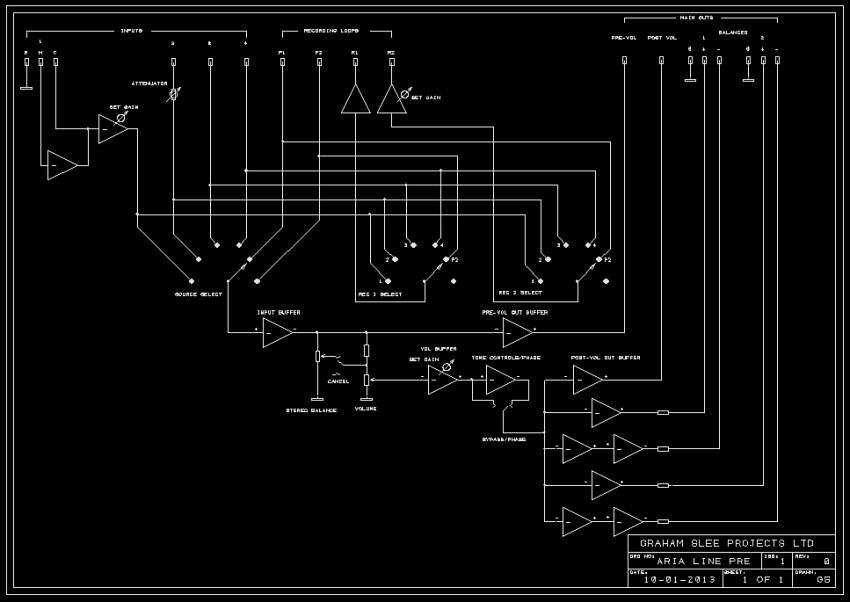 ------------- That none should be able to park up and enjoy the view without a smartphone and the knowledge in how to use apps |
Posted By: digital man
Date Posted: 10 Jan 2013 at 5:01pm
|
Well, I see that the tone feature is bypass-able (is that a word?), so I'm probably going to vote yes. Why not? I just hope that the boost and cut is gently constructive rather than severe. Speaking of gently constructive : The balance control. How about trimming the left of right slightly rather than having a full left or full right balance control? I don't need a balance control at all, but I could see how someone might want to lightly shift the balance one direction or the other. Just a thought. Hey, this is exciting! 
|
Posted By: Fatmangolf
Date Posted: 10 Jan 2013 at 6:05pm
|
That looks very good to me. Thanks Graham.
------------- Jon Open mind and ears whilst owning GSP Genera, Accession M, Accession MC, Elevator EXP, Solo ULDE, Proprius amps, Cusat50 cables, Lautus digital cable, Spatia cables and links, and a Majestic DAC. |
Posted By: ICL1P
Date Posted: 10 Jan 2013 at 6:21pm
|
I'll just pretend to be impressed, but it's all way beyond me. I can cope with pigs and a shovel, but circuit diagrams are beyond me. ------------- Ifor ===== Reflex M & ACCESSION M, CuSat50, Majestic DAC, a Proprius pair. |
Posted By: suede
Date Posted: 10 Jan 2013 at 6:45pm
Same here, might as well have been a transit map for all I know. I'm just glad others know how to read and make them so that I can have electronic things |
Posted By: BackinBlack
Date Posted: 10 Jan 2013 at 8:59pm
|
Looks good to me. Fixed and variable outputs, balanced in and out, volume, tone control bypass and balance control. I would agree with digital man in that the balance control doesn't need to go to zero, but perhaps that is just a circuit representation rather than actual. This is obviously a hot topic judging by the number of new forum members, welcome to all!!!! |
Posted By: Graham Slee
Date Posted: 11 Jan 2013 at 6:02am
|
On the subject of stereo balance control, I too agree that the extreme "max/off" isn't for me. However, think about it? A narrow range of adjustment can result in the control being at or near its extremes. When so many are configured so a slight offset of the control gives a noticeable shift of stereo image, there may be a natural aversion to a more range specific control? I've done it myself. I've built balance controls with something like +/-3dB to find with some albums the control is parked near to its extreme one direction or the other. I've been a bit worried about doing that on a production product. Customers could think it a fault? "Why is your balance control so different to my XYZ Graham?" Apart from that user worry, such a balance control is easier to implement IMO. It would be a simple gain pot with one gang wired the reverse of the other - a linear control. However, as any potentiometer manufacturer, including Alps, will tell you, it is impossible to get both gangs of a pot to match perfectly over its entire range. Even the AC30 so loved by all and sundry (IMO hype) isn't gain matched. Therefore any preamp will be biased in level toward one channel or the other, unless on-board gain trimmers are included and channels balanced on test during production. Those tests cannot be automated because they require an amount of human reasoning because gain matching varies with a pot's position. This is just another thing you wouldn't know. Whilst on the subject of pots, you may not know that the larger UK and European competing manufacturers dictate to the importers of a certain (hype) potentiometer on who is allowed to buy what. Do you find that shocking? Yes, I did too! The pots in question would sell to these manufacturers for around £4 each, that's motorised... take a look on Rapid, you'll find them for over £20 including VAT. Such is the hype level applied by the importers, or maybe the manufacturer itself... These pots are carbon track at the end of the day. Conductive polymer or as it used to be called: conductive plastic, is far more superior - is still made to this day in the UK (and also the US) - and isn't made by cheap labour as is the carbon elements used by the Japanese manufacturer being talked about here. I have stocks of motorized pots made by one of the element subcontractors, but they don't carry the "famous name". Do you think the average audiophile would accept "such rubbish" even though it's the same "rubbish" that's perfectly OK because it carries the name? For those who are willing to accept manual adjustment I will try to use the superior British made conductive polymer pots. Apologies to those who because of life's mishaps must have remote controlled volume. I have popped the question to the British manufacturer about adding a motor. ------------- That none should be able to park up and enjoy the view without a smartphone and the knowledge in how to use apps |
Posted By: BackinBlack
Date Posted: 11 Jan 2013 at 9:10am
|
Graham, Thanks for the reasoned explanation, it does now make sense to me. The Hype surrounding some specialist audio components is difficult to justify when you listen to them. The "Kings new clothes" syndrome is alive and well, particularly when it comes to some of the outlandishly priced "high end" audio components. |
Posted By: Graham Slee
Date Posted: 11 Jan 2013 at 1:41pm
|
The next part of the Aria preamp development I'm revisiting is the remote control. I've not been happy with the conventional remote control arrangements. The motorised volume control is the way to go. Variable gain amplifiers are not to be trusted - their characteristics change with every change in volume control setting. The problem with motorised pots is they are not without noise, and the power has to come from somewhere. It's bad enough making sure every amp stage is happy with its power never mind the noise from a DC motor getting shunted back up it's Kelvin/Kirchhoff current return. I want the "pure" power of a PSU1 supplying this preamp. I feel 125mA (stall current) is a waste of PSU1 quality. So what's the answer? Rechargeable batteries! "Build in rechargeable batteries Graham!" I said, but to comply with the EU, make them removable so they can be replaced after umpteen years so the preamp lasts "forever". A trickle charge of the PSU1 won't muck up the supply to the audio circuits. And whilst we're at it why not have a recharging point to recharge the handset? So that's the next stage of development being thrashed out. There are many matters to iron out before the PCB can be drafted - most of it is waiting for suppliers... ------------- That none should be able to park up and enjoy the view without a smartphone and the knowledge in how to use apps |
Posted By: ServerBaboon
Date Posted: 11 Jan 2013 at 5:32pm
|
Is the demand for the Remote control strong? I know personally that I have said it would be nice but I suspect that I could live without them, especially knowing the hurdles you are having to jump through. ------------- Steve ------------- Various bits of GSP Kit ..well two so far, unless you count the cables that is. |
Posted By: digital man
Date Posted: 11 Jan 2013 at 6:15pm
I personally don't need remote. Maybe another poll is in order? Or maybe there are already too many cooks in the kitchen.  I don't know how much room there will be inside the case,,, but did you consider stepped attenuators for the volume control? The switching mechanism is expensive, and the labor to wire the resistors adds to the cost, but it's another way to get good matching and you can pick your flavor of resistor. Just a thought. |
Posted By: iamalexis
Date Posted: 11 Jan 2013 at 10:36pm
| Really looking forward to the outcome of this and enjoying reading the thread. Good luck with this next stage of development! |
Posted By: Graham Slee
Date Posted: 12 Jan 2013 at 6:18pm
|
Whether or not the demand for remote control is strong, if it isn't on offer many will not bother to consider the Aria. I developed the remote control circuitry some months ago. It is completely different to any conventional remote control to avoid clashes between equipment. It is still an IR control and the signal is coded so no worries about ambient lighting having an adverse effect. The motorised pot and remote control receiver can be housed on a sub board which could be retro-fitted after removal of the non motorised pot which would be fitted to the manual version. Therefore those who do not want remote control can buy the manual version, and those who do want remote control can buy the remote control version. And those who want to upgrade to remote control can have it upgraded also. Having worked on professional high end studio equipment I know the virtues of conductive polymer potentiometers. I am hoping to make conductive polymer the standard volume control on the manual version, and I will be trying some out on my Solo Ultra Linear DE first because it is a lot easier hearing differences on headphones. I also intend to make a stereo balance pot a standard issue. However it will only give +/- 3dB at full travel and its effect when centered or even slightly off centre will be virtually zero. And after all, it doesn't mix any left with right - all it can do is vary the gain so I just don't know what the fuss is about... come on, which idiot frightened people? I'd like to know? As for reliability, this is why I am so interested in conductive polymer. You can pay a fortune for other preamps fitted with carbon if you want. The reason for using conductive polymer in studio gear is for reliability and quality. Carbon is carbon... it is what the "lead" of a pencil is made of. And lastly (in this reply), what good are switched attenuators? How many switch contacts are there? 24? 36? Quite a lot of switch contacts to go faulty. All those bits of metal rubbing against other bits of metal. Not bad if they are hard gold plated - and hard gold plate is 9 carat and not the 22 carat I've seen being talked about so much about in hi-fi, and which is as soft as... Source selectors have to be switches, but they are not subject to the rate of adjustment switched attenuators would be. Most good quality rotary switches are rated for 10,000 operations. Work it out for yourself. Sometimes I have to ask if hi-fi is about a load of people just crying out to be conned? Graham ------------- That none should be able to park up and enjoy the view without a smartphone and the knowledge in how to use apps |
Posted By: morris_minor
Date Posted: 12 Jan 2013 at 6:43pm
------------- Bob Majestic DAC/pre-amp Accession MC/Enigma, Accession MM, Reflex M, Elevator EXP, Era Gold V Solo ULDE, Novo, Lautus USB and digital, Libran balanced, CuSat50 2 x Proprius + Spatia/Spatia Links |
Posted By: Fatmangolf
Date Posted: 12 Jan 2013 at 9:10pm
It's starting to sound a lot like great British Hi-fi.  And its eminence is imminent. And its eminence is imminent.------------- Jon Open mind and ears whilst owning GSP Genera, Accession M, Accession MC, Elevator EXP, Solo ULDE, Proprius amps, Cusat50 cables, Lautus digital cable, Spatia cables and links, and a Majestic DAC. |
Posted By: BAK
Date Posted: 29 Mar 2014 at 10:27pm
Graham, I thought your above statements needed restating. One could not state your design/work ethic any better! True dedication to transparency in sound reproduction. The ARIA Line Stage may be still needed?  I'm sure the consumer market would like the remote/manual volume option. I for one would like to see it, maybe call it the DOVE connection? Gotta love a DOVE! ------------- Bruce AT-14SA, Pickering XV-15, Hana EL, Technics SL-1600MK2, Lautus, Majestic DAC, Technics SH-8055 spectrum analyzer, Eminence Beta8A custom cabs; Proprius & Reflex M or C, Enjoy Life your way! |
Posted By: morris_minor
Date Posted: 30 Mar 2014 at 2:12pm
|
Well worth re-posting that Bruce! (BTW, weren't The Ambassadors of Correctness the post-punk brothers of The Sultans of Swing? )------------- Bob Majestic DAC/pre-amp Accession MC/Enigma, Accession MM, Reflex M, Elevator EXP, Era Gold V Solo ULDE, Novo, Lautus USB and digital, Libran balanced, CuSat50 2 x Proprius + Spatia/Spatia Links |