Cock-ups With Ceramics
Printed From: Graham Slee Hifi System Components
Category: Find what you're looking for here!
Forum Name: Graham Slee Blog [sponsored by Cadman Enterprises Ltd]
Forum Description: This category is where Graham Slee comments - you can reply - but the rest of the forum is for members postings
URL: https://www.hifisystemcomponents.com/forum/forum_posts.asp?TID=5607
Printed Date: 27 Mar 2026 at 3:31am
Software Version: Web Wiz Forums 12.01 - http://www.webwizforums.com
Topic: Cock-ups With Ceramics
Posted By: Graham Slee
Subject: Cock-ups With Ceramics
Date Posted: 28 Mar 2023 at 12:35pm
|
How did the ceramic cartridge die? Were they really crap? Or was it because the "RIAA curve" wasn't understood? One statement should have led to understanding, but it simply went straight above most heads. "there is bass boost below 50Hz" Take a look at all those RIAA curves and see if you can find it. You cannot! But back then in my early twenties, I was a mere beginner and thought the writers of electronics magazines and books knew everything, and I must be missing something - it had to be my fault. It was not until an article by Gary A. Galo "Disc Recording Equalization Demystified", originally published in 1996, that I understood it wasn't my fault after all. The only way the replay RIAA curve can show the bass boost is by tipping it to the right by 45 degrees. At that point, it can be seen that the response is shelved down between 500Hz and 2122Hz, and then it eventually clicks that the output of a magnetic cartridge must be rising at 20dB/decade. But a ceramic cartridge doesn't do the same as a magnetic cartridge! ------------- That none should be able to park up and enjoy the view without a smartphone and the knowledge in how to use apps |
Replies:
Posted By: Graham Slee
Date Posted: 28 Mar 2023 at 10:02pm
|
What do we need to know to use a ceramic cartridge correctly. 1. the frequency response According to the National Semiconductor Audio/Radio handbook (1980), the frequency response is constant amplitude, which means flat, so if the record has flat output the cartridge output will be just as flat. It should be noted that the crystals used didn't have an extended high frequency response and often struggled to go beyond 10kHz. But how many musical instruments get higher than 10kHz? Probably only the higher harmonics. Also according to the same book, the RIAA record amplitude falls between 500 and 2000Hz, and that is supposed to be a fall of 12dB. But as everybody knows (??) the 500Hz and 2000Hz corners are not sharp corners. If the frequencies are to be believed, then at 500Hz there is -3dB compared to lower frequencies, and at 2000Hz there is +3dB compared with higher frequencies, so between 500Hz and 2000Hz there can only be 12dB - 3dB - 3dB = 6dB. (a sheet metal worker will understand such bends as set-backs and bend allowances) 2. the source capacitance According to my Peak LCR meter, the source capacitances of a Sonotone 9TA and a BSR ST20 are somewhere between 500pF and 600pF, so we could perhaps take that to be 550pF. 3. the RIAA record 50Hz boost This is the flat portion of the velocity/RIAA response at the beginning of the plot on the left of the graph. If tipped to the right it would be flicked up to its left. That indicates the pre 50Hz boost, so the response is up by 3dB at 50Hz. With a 550pF source capacitance the input impedance of the preamp should be 1/2pi * 0.00055uF * 50Hz = 5.787 Meg-ohms. Ever seen such a preamp? Exactly. ------------- That none should be able to park up and enjoy the view without a smartphone and the knowledge in how to use apps |
Posted By: Graham Slee
Date Posted: 28 Mar 2023 at 10:41pm
|
This is a circuit from Practical Wireless in 1976 with component values for a Sonotone 9TA. 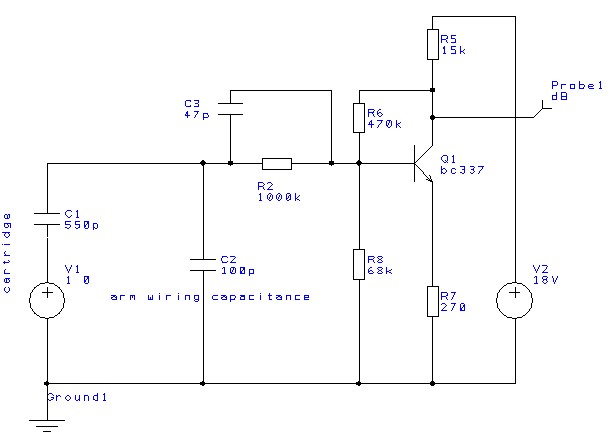 It looks more like a converter to make it into the velocity/RIAA replay response. 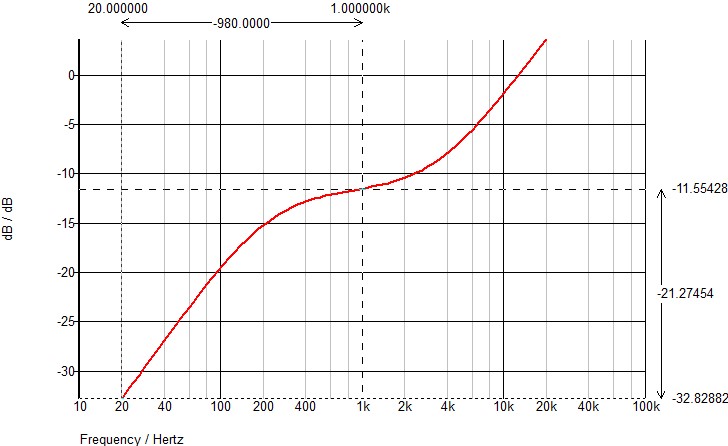 But gave a better result than just loading it with 50k ohms like most DJ decks - see dashed green curve. 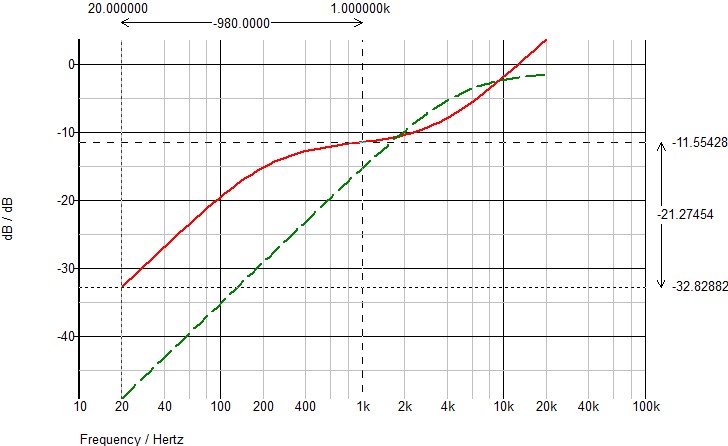 ------------- That none should be able to park up and enjoy the view without a smartphone and the knowledge in how to use apps |
Posted By: Graham Slee
Date Posted: 28 Mar 2023 at 10:57pm
But, if you really want the cheapest and quickest trick to convert a ceramic cartridge to a velocity response suitable for a magnetic phono preamp, try putting a 3k3 resistor in parallel with the input.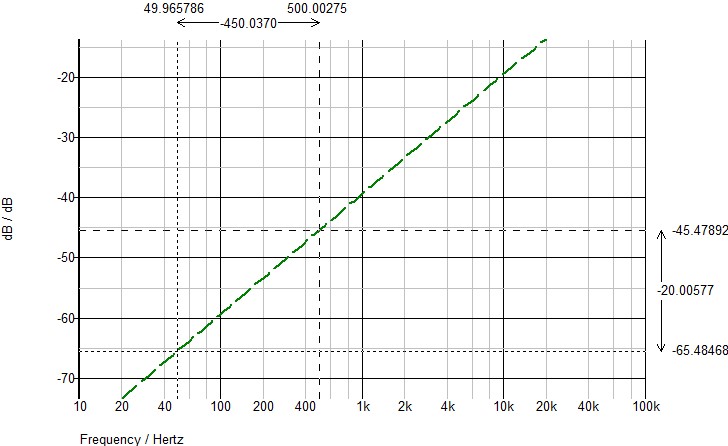
If it's too quiet, increase the resistance to say 10k, and if too loud, drop it to 1k. Warning: I haven't tried this yet. ------------- That none should be able to park up and enjoy the view without a smartphone and the knowledge in how to use apps |
Posted By: Graham Slee
Date Posted: 29 Mar 2023 at 6:29pm
|
I thought I'd give the simple load resistor a try, but I thought there wouldn't be enough output so instead of 3k3 I went for 13k, because I've rather a lot of them. ------------- That none should be able to park up and enjoy the view without a smartphone and the knowledge in how to use apps |
Posted By: Graham Slee
Date Posted: 29 Mar 2023 at 6:58pm
|
3k3 now, and the level is about right. Bass is quite reasonable, but the upper shelf frequencies are a tad bright, so I set my Accession M to the "American" (NAB) EQ which tamed it a bit. This suggests the 9TA cartridge has a rising response and that's shown in the plot on Roger Russel's site. It's up about 3dB. ------------- That none should be able to park up and enjoy the view without a smartphone and the knowledge in how to use apps |
Posted By: Graham Slee
Date Posted: 29 Mar 2023 at 9:01pm
Here's my nude Astatic 9TAHC (high compliance). Same load as above. Same NAB EQ. Much better sound quality. ------------- That none should be able to park up and enjoy the view without a smartphone and the knowledge in how to use apps |
Posted By: Graham Slee
Date Posted: 29 Mar 2023 at 9:34pm
|
I've eventually settled on a load of 1k3 which attenuates the cartridge so I obtain a healthy level at an 11 o'clock volume control setting, and flicking the Accession M to RIAA isn't as bright as before, and might even be acceptable on playing other records than the brightly lit "Wind And Wuthering." So, how to make? A phono plug, a phono socket, some short bits of wire, and a 1k3 resistor (metal film), times 2 for stereo. Your own super cheap Velocitone adapters! And hum free! Perhaps call it the Bogart?
------------- That none should be able to park up and enjoy the view without a smartphone and the knowledge in how to use apps |
Posted By: Mikeh
Date Posted: 29 Mar 2023 at 10:55pm
|
I remembered an old thread on Vinyl Engine discussing a similar simple approach for ceramic cartridges ( https://www.vinylengine.com/turntable_forum/viewtopic.php?f=19&t=82160&start=84#p792242 - https://www.vinylengine.com/turntable_forum/viewtopic.php?f=19&t=82160&start=84#p792242 ). There was an picture of a headshell solution..  From your findings, I take it that the resistor and plugs approach could be tried for different cartridges (I have an 8TA) to determine the appropriate match for individual cartridge characteristics. ------------- Mike Technics sl1210g with Victor U-2 or Technics EPC-205C mk4 Accession MM, Majestic + Proprius, Solo ULDE Innuos Zen mini mk3 streamer Harbeth P3ESR XD paired with 2x REL t5x |
Posted By: Graham Slee
Date Posted: 30 Mar 2023 at 11:52am
Those guys must think I'm crazy doing things with "ancient" technology. But, to be blunt, I don't care what they think. It's an interest, and if nobody has that interest, then the history went down the memory hole. But maybe this is the end of history. The **** all that throw away attitude that got us all here in the first place. Where we just sit on our fat arses doing didly squat and complain about climate change while making it happen but not in our backyard. Did I tell you I've a book on my shelf titled Calling Bullsh*t? Anyway, it was nearly 50 years ago when I started worrying about why nobody could explain to me what should have been simple - and I now want closure! End of rant  ------------- That none should be able to park up and enjoy the view without a smartphone and the knowledge in how to use apps |
 Mikeh wrote:
Posted By: Mikeh
Date Posted: 30 Mar 2023 at 2:11pm
I don't think there is any implied craziness, more the contrary. There appears to be a band of enthusiasts for making ceramic cartridges sound their best. The link was merely illustrating a similar approach. One pic showing additional circuit components fitted in a headhsell and another discussing exactly the same approach as you have suggested, adding in-line components. ------------- Mike Technics sl1210g with Victor U-2 or Technics EPC-205C mk4 Accession MM, Majestic + Proprius, Solo ULDE Innuos Zen mini mk3 streamer Harbeth P3ESR XD paired with 2x REL t5x |
Posted By: Graham Slee
Date Posted: 30 Mar 2023 at 8:27pm
|
Isn't SPICE great? Without it I'd have to make my imagination and mathematical modelling work really hard. Unfortunately, by now, not practising mathematical modelling on a daily basis, I forgot something like 90% of what I knew to pass the exams. Just what do those Velocitone adapters do? Well, so far I know that the load resistor (my 1k3 and their 10k) changes the flat output to constant velocity. But my 1k3 idea, even though good in some respects, still sounds a little bright. So, I thought I'd model the Velocitone, and in that lies the answer! See that 68k resistor and the 500pF capacitor across it? I thought that it maybe dulled the highs a bit? And it does! Drool over this graph...  See how it shelves down the upper frequencies? The green line is the reference showing constant velocity, and the red curve shows it correcting for the brightness I experienced, and it's around 5 to 6 dB, which correlates with my guess of a 6dB shelf instead of the 12dB magnetic shelf response. ------------- That none should be able to park up and enjoy the view without a smartphone and the knowledge in how to use apps |
Posted By: Graham Slee
Date Posted: 30 Mar 2023 at 8:42pm
|
Now, using a 1k3 load and the same Velicitone series component values (68k || 470p*), all that happens is some 18dB level reduction. So, each curve has its reference constant velocity straight curve for comparison, and the only deviation is about 0.3dB at 10kHz between the two levels, which is very acceptable.  So now to try and build the Velocitone into the head shell like that guy on Vinyl Engine! This will be fun considering my failing eyesight (* 470pF is the nearest available value to the 500pF of the Velocitone circuit diagram) ------------- That none should be able to park up and enjoy the view without a smartphone and the knowledge in how to use apps |
Posted By: Graham Slee
Date Posted: 30 Mar 2023 at 11:21pm
|
So, how does it work? First of all you've a capacitor driving a signal into a load. The capacitor is the cartridge, or perhaps best explained that the ceramic (or crystal) cartridge is a capacitor coupled generator. So a capacitor into a load resistor is a CR network, which is a high-pass network, and with a load of 10k ohms (like the Velocitone) and a cartridge that's around 550pF, the turnover frequency is 1/2pi * 0.01 * 0.00055 = 28,937 Hz So signals below 28.937kHz are cut at the rate of 20dB per decade, making for a slope rising at 45 degrees to the right on a 180 degree graph. And if you make that load even lower, it's still the same slope but the cut happened even further up in frequency. Either way, it doesn't matter because it encompasses the entire 20kHz audio band. Got that? And now how the Velocitone bends that upper curve... Note that 68k resistor. It's a series resistor, so the load the cartridge sees is 68k plus the 10k load, making 78k, so the curve gives at 1/2pi * 0.078 * 0.00055 = 3710 Hz Now, turnover is -3dB, so at about 4kHz you see the curve has departed somewhat, and would keep doing so until it was flat, but! The 68k is bypassed by a 500pF capacitor, so it sees a load of 10k, and the cartridge isn't far off being 500pF (550pF on average) so it divides by two! And two in dB's is 6dB, so it gradually departs and then goes parallel with the constant velocity curve on it reaching 6dB. So, it's a crafty network that compensates for the PZT (lead-zirconium titanate) upper frequency response. Now, a Rochelle salt crystal cartridge struggles at high frequencies, so would not require the high frequency (68k || 500pF) correction, so all you'd need for a old BSR ST20 (or similar) would be the 10k (or 1k3 in my case) load. And the Rochelle salt exhibits the same measured capacitance, so with the flick of a switch, you can have one or the other. And via a selector switch you can have 1. ceramic; 2. magnetic; and 3. line, from one preamp circuit, which is the one I've been developing over on the 7eventy amp blog. ------------------------------------------------ Huh, my maths fell apart as you'd note if you printed the graphs and ruled the frequency at which the lines diverge at a 3dB difference. You'd find the frequency is about 2.5kHz and not the 3.7kHz I said. Now, that's about a 1.414 difference, and that's got to be something to do with capacitive reactance - there being two in series (the cartridge and the 500pF). But, it all depends how you see the circuit. Across the 68k resistor there is one 500pF capacitor. Then there's a 550pf capacitor (the cartridge) across the 68k and 10k in series. So it becomes a complex bit of maths. But if you exclude the 10k, then there's 500pF || 550pf || 68k, so that's 1.05n || 68k, and 1/2pi * 0.00105 * 0.068 = 2229 Hz And that's a bit closer to the 2.5kHz the simulation graph shows. So, there's my correction. ------------- That none should be able to park up and enjoy the view without a smartphone and the knowledge in how to use apps |
Posted By: Graham Slee
Date Posted: 01 Apr 2023 at 5:38pm
|
So what is the right level of attenuation we need to feed the ceramic signal into an MM sensitivity phono stage? Firstly that depends on the sensitivity (at 1kHz) of the phono stage, but rather than talk of it in voltage, we could try signal level in dB (decibels). Most MM phono stages give 40dB 1kHz gain. We expect about 300mV out of the MM phono stage to suit the sensitivity of the line input of a preamp or integrated amp. So, what's the rated output of the 9TA cartridge? Some say 70mV. Some say 0.4V. Others say 0.2V (0.2V = 200mV). Well, one thing I can be certain of is 200mV is close enough to what the average line input sensitivity used to be on most amps. And that's the sort of output level you'd expect from an MM amp with a 2mV output MM cartridge - such as a Gram Amp 2. So, the lines on the graphs I've been showing you really ought to be crossing 1kHz at -40dB. Now, -40dB is a hundredth, and the rate of cut is 20dB per decade, so if it's -40dB at 1kHz, the high pass cut needs to be at 100kHz. The source capacitance is 600pF (+/-10%), so by 1/2pi * C * F Then the value of the load needs to be 1/2pi * 0.0006 * 100,000 = 2.65k And as the input impedance of a MM stage is 47k, then the resistance in parallel with it that gives 2.65k is 1/(1/2.65 - 1/47) = 2.8k The nearest commonly available value is 2.7k, so I'll be using that. So that sets it at the minimum recommended range for a Gram Amp 2, so if we use a selection of ceramic cartridges with some up to 1V output, we're covered. The rest of the circuit is that series 68k || 470pF between the pick-up and the load resistor. Another thing to note is the 100pF arm cable capacitance. If the "Velocitone" is at the phono stage input, the cable divides the cartridge output down by 20 * (log of 1 + (100pF/600pF)) = 1.3dB If the "Velicitone" is placed in the head shell, the arm cable capacitance comes after, and therefore does not attenuate the signal. 1.3dB hardly matters either way, so the "Velocitone" can be put where it's most convenient.
------------- That none should be able to park up and enjoy the view without a smartphone and the knowledge in how to use apps |
Posted By: Graham Slee
Date Posted: 01 Apr 2023 at 8:01pm
|
So how does it sound this time? I'm using an old Gram Amp 2 Communicator and I think it has the NE5532 op-amp, so is sweet sounding in the upper mids, and I'm playing "Milagro" by Santana, which is a quiet recording, and so the Majestic preamp is up at 12 o'clock. The hissy brightness is gone. In fact, I'd call it smooth with extra o's. Does it trawl the bass? No, it's slightly light, but the bass is definitely there, but lacking a little authority. I've built the "Velocitone" on a piece of parallel tag strip, and I'll photograph it later so you can see how simple it is. It's all scrap box apart from the resistors and capacitors being new stock. Perhaps I should do as I say and let it age a few days. ------------- That none should be able to park up and enjoy the view without a smartphone and the knowledge in how to use apps |
Posted By: Graham Slee
Date Posted: 01 Apr 2023 at 8:35pm

------------- That none should be able to park up and enjoy the view without a smartphone and the knowledge in how to use apps |
Posted By: Sylvain
Date Posted: 01 Apr 2023 at 9:07pm
| This is proving interesting .....I remember the 60's Ceramic cartridge and this so e well x elaborated and eplained may ditch the Dynavertor 10, cheapest version, for the distinct Ceramic sound. And I thought ceramic was the better evolution of the Gramophone but here to complement Op-Amp technology |
Posted By: Mikeh
Date Posted: 01 Apr 2023 at 9:33pm
|
It seems Sonitone did a pretty good job with the original Velocitone and ceramics can sound better than their image when hooked up to good electrics. Makes me wonder what more modern materials science would add to the story. ------------- Mike Technics sl1210g with Victor U-2 or Technics EPC-205C mk4 Accession MM, Majestic + Proprius, Solo ULDE Innuos Zen mini mk3 streamer Harbeth P3ESR XD paired with 2x REL t5x |
Posted By: Graham Slee
Date Posted: 02 Apr 2023 at 10:32am
|
Update on SQ. I ought to have used brand new phono sockets as the LHC kept cutting out. A goodly amount of "exercising it" seems to have made it make better contact, but there is obviously that lingering doubt. I will have to use a plastic box and machine it for the "PCB" type pressed metal sockets we use on products the next time. Some think them inferior, and the gold plated single screw on sockets superior, but I've got news for them... The sound quality, i.e. tonal quality, improved with use. The bass became fuller. Just leaving it on won't improve it simply because it is a passive circuit. Current has to flow for a circuit of electronic components to age, and so it can only age through use. The next vinyl to play was "To Our Children's Children" by the Moody Blues. The intro didn't sound as dramatic as I'm used to and was tonally all over the place, but here I'm nit picking. There is a definite stereo image, and I think it will give perspective and be lucid. However, some of that felt a bit restrained, but might be because of the "nudity" of the cartridge. If I remember correctly, some removed the metal jacket in a bid to make the cartridge sound less tinny. Obviously they were not using the Velocitone into a good MM phono stage. Downforce is set to 2.5g (mn) and very little bias. VTA might be out and I will have to try magnification to see the stylus tip angle. It should be 20 degrees to the vertical and I think it might be shallower. I am using two Technics 2g head shell weights, without which the arm will not balance within its range. I got a new aftermarket replacement stylus from "Get The Needle" run by a chap called Tony Hughes, who says he has a number of 9TA stylus left. I have yet to try the new stylus. It's an LP/LP flip over. ------------- That none should be able to park up and enjoy the view without a smartphone and the knowledge in how to use apps |
Posted By: Graham Slee
Date Posted: 06 Apr 2023 at 9:33am
|
The record player's been playing music, but not in the accepted way. I don't mean that the record player was playing records while suspended in a bath of water, no, I mean I've not been playing the accepted stuff. I've dared not to play "the 10 most difficult rock records to test your hi-fi" or other cult/marketing BS (otherwise known as link juice in the money desperate SEO/life coach world). No, I played "Fragile" by Yes, and "Hunky Dory" by David Bowie. There's something really musical about hearing music, don't you think? I think I'll dig out my Peter Gabriel album, the one known as "Peter Gabriel," and I'll play "A Wonderful Day In A One-Way World." You know it's one way when you hear music so good via something that the world took away. ------------- That none should be able to park up and enjoy the view without a smartphone and the knowledge in how to use apps |
Posted By: Chris Firth
Date Posted: 06 Apr 2023 at 11:52am
|
Do you have PG's 1st album, Graham. The tracks that start and end the album bring their own challenges for playback, and then there's the glorious Solsbury Hill, with its unusual time signatures, simple sounding but oh so complicated and a total bastard to play guitar part (thanks Steve Hunter for creating your own part off the cuff to frustrate guitarists the world over forever). |
Posted By: Graham Slee
Date Posted: 07 Apr 2023 at 12:37pm
|
Genesis were Tudor "Christian" tripping rock as far as I'm concerned. They became that after Jonathan King buzzed off. From Genesis to Revelation sounded very evangelical "we hope you join us" etc. Either that or they were taking Le Pice. Who knows? Perhaps they didn't either. But lyrics like "the changes of no consequence will pick up the reigns from nowhere" (Seven Stones) seemed to be psychologically designed. I got the impression that Gabriel was on a God trip, but the musical press did their best to hide it for him. "Watcher of the Skies" had more overtones with the book of Enoch (pseudographia) - think looking down rather than up. "Lamb Lies Down" with references to Rael, and eventually singing "is Rael", plus "Counting Out Time" (the book of Numbers) should have been a dead giveaway. So when you get to "Solisbury Hill," you'd be able to make 2 + 2 = 4, but only if you'd followed. ------------- That none should be able to park up and enjoy the view without a smartphone and the knowledge in how to use apps |
Posted By: tesladan
Date Posted: 22 Oct 2025 at 11:18am
|
Last time I used a turntable with ceramic cartridge was when I was 16 ( early 1970's ) My parents Electrohome console stereo had a Dual 1219 in it. I remember articles in " Stereo Review " magazine stating ceramic cartridges were garbage as they track to heavy and destroy your records... Learning something new here. Are there ceramic cartridges even still in production? ------------- Dan |
Posted By: Fatmangolf
Date Posted: 22 Oct 2025 at 5:08pm
|
Graham Slee would be the best source on this. ------------- Jon Open mind and ears whilst owning GSP Genera, Accession M, Accession MC, Elevator EXP, Solo ULDE, Proprius amps, Cusat50 cables, Lautus digital cable, Spatia cables and links, and a Majestic DAC. |
Posted By: tesladan
Date Posted: 22 Oct 2025 at 5:11pm
|
Thanks ------------- Dan |