Mains conditioning
Printed From: Graham Slee Hifi System Components
Category: DIY AUDIO
Forum Name: DIY Audio questions and answers
Forum Description: www.diy-audio-kits.com ... superb audio kits for experienced constructors
URL: https://www.hifisystemcomponents.com/forum/forum_posts.asp?TID=4157
Printed Date: 27 Mar 2026 at 4:04am
Software Version: Web Wiz Forums 12.01 - http://www.webwizforums.com
Topic: Mains conditioning
Posted By: peterb
Subject: Mains conditioning
Date Posted: 04 Mar 2017 at 10:44am
|
One of the troubles with making your own HiFi components is that there always seems to be another small improvement that can be made, just to get it to the next level ! I have been 'on the case' regarding the background noise from my PreAmp and which I have now identified as due to mains noise. The PSUs in it are fed from a Filter Mains connector and use linear voltage regulators but despite that it seems a lot of higher frequency spikes are getting through. I am considering buying a Mains conditioning extension lead to add extra filtering to the supply. Does anyone have experience of such things, do they work? Are there any limitations? For example can they limit the instantaneous current that a Power Amp might demand. Can anyone recommend a best buy? Thanks ------------- Peter --------------------------------------- Dual 505-1, Cyrus CD T, DIY 80W MosFet amp and PreAmp, 2xKEF 103.2 |
Replies:
Posted By: Fatmangolf
Date Posted: 04 Mar 2017 at 10:59am
|
Hi Peter, I found it helps more on source components but not on powerful amplifiers like subwoofers which were less dynamic. The impact on the Proprius amps (I ran one channel direct from the wall socket and one filtered) was inaudible bar the odd thermostat spike. The prices go very high and I'd rewire for a clean mains line to the hifi (other here have done this with VG results I believe) rather than spend four figures on filters. A cheapish test you could try is one of the Tacoma filters Richer Sounds sell, like the CS947. ------------- Jon Open mind and ears whilst owning GSP Genera, Accession M, Accession MC, Elevator EXP, Solo ULDE, Proprius amps, Cusat50 cables, Lautus digital cable, Spatia cables and links, and a Majestic DAC. |
Posted By: Richardl60
Date Posted: 04 Mar 2017 at 1:56pm
|
Peter when you refer to noise and spikes do you mean clicks/pops? Also are these audible on everything or just certain sources? I have tried mains purifiers in the past and sold them on as I could not tell any meaningful differences. Cannot comment on spike/surge protection though my power block does have some protection. As outlined above, feeding a separate mains fed from an independent consumer unit certainly should help the overall sound, but how much it will impact on spikes and other interference it will depend on where this is coming from, I suspect not a great deal personally. I used 10mm twin and earth for my dedicated mains spur. |
Posted By: Fatmangolf
Date Posted: 04 Mar 2017 at 3:58pm
|
As richard says it would depend what is putting the spikes and interference on the local mains but I found plug-in spike suppressors next to my fridge and my chest freezer helped. ------------- Jon Open mind and ears whilst owning GSP Genera, Accession M, Accession MC, Elevator EXP, Solo ULDE, Proprius amps, Cusat50 cables, Lautus digital cable, Spatia cables and links, and a Majestic DAC. |
Posted By: gwebster
Date Posted: 04 Mar 2017 at 4:23pm
|
Have a look at the PSU circuit diagrams for your DIY amps and check if there are any snubbing capacitors across the rectifier diodes (the ones connected between your mains transformer and the big smoothing capacitors (the unregulated dc before the regulators). Without these, the transients as the rectifiers turn on/off on each mains half-cycle generate nasty spikes which may be your problem. Something like 47nF ceramic discs capacitors in parallel with each of these rectifier diodes should help eliminate the problem. |
Posted By: peterb
Date Posted: 04 Mar 2017 at 4:45pm
|
Thanks Jon and Richard for your comments. I thought of running a new mains spur but it would be very difficult in my old Edwardian house. What started this off was putting my ear to the speakers and noticed more white noise from the left than the right channel. I then checked with a scope and saw the baseline circuit noise was supplemented by some higher frequency blips every 100Hz, of variable levels. I hoped I would be able to identify the culprit but so far have failed. I thought a possible solution would be a product like the Tacima CS947, about £35, which you mentioned Jon, but I wondered if anyone had experience of it. ------------- Peter --------------------------------------- Dual 505-1, Cyrus CD T, DIY 80W MosFet amp and PreAmp, 2xKEF 103.2 |
Posted By: gwebster
Date Posted: 04 Mar 2017 at 5:16pm
|
That 100Hz stuff is the transients from the rectifiers (see my previous post). PS - don't forget there's a Genera sitting here you can try out. PM me. |
Posted By: peterb
Date Posted: 04 Mar 2017 at 5:20pm
|
Trying and failing too load jpegs of the scope snapshots, they seem to come out too large?? ------------- Peter --------------------------------------- Dual 505-1, Cyrus CD T, DIY 80W MosFet amp and PreAmp, 2xKEF 103.2 |
Posted By: peterb
Date Posted: 04 Mar 2017 at 5:24pm
|
Thanks for the reminder about the Genera. I still waiting for the replacement of my Ortofon Blue, promised next week !! One of the jpegs I wanted to post was the PSU circuit diagram, which does include snubber caps. ------------- Peter --------------------------------------- Dual 505-1, Cyrus CD T, DIY 80W MosFet amp and PreAmp, 2xKEF 103.2 |
Posted By: peterb
Date Posted: 04 Mar 2017 at 6:09pm
|
PSU Schematic 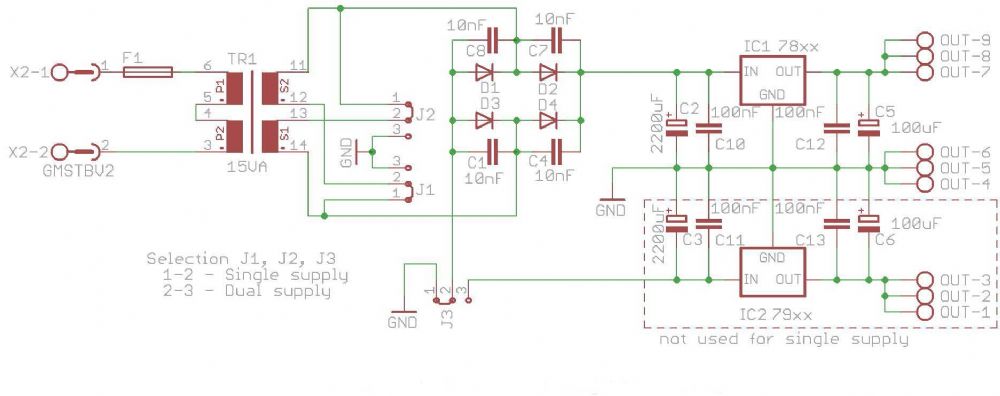 ------------- Peter --------------------------------------- Dual 505-1, Cyrus CD T, DIY 80W MosFet amp and PreAmp, 2xKEF 103.2 |
Posted By: peterb
Date Posted: 04 Mar 2017 at 6:12pm
|
Scope snapshot of best case noise. Red = Right channel, Blue = Left Channel, Spectrum of Left channel  ------------- Peter --------------------------------------- Dual 505-1, Cyrus CD T, DIY 80W MosFet amp and PreAmp, 2xKEF 103.2 |
Posted By: Richardl60
Date Posted: 04 Mar 2017 at 6:14pm
|
Cannot comment on the technical side at all but my simple logic tellls me that if left/right channel differ it may not be mains related, either a feature of the electronic or cable dressing? My mains feed is external on the outside of the house but another option may be under floorboards? |
Posted By: peterb
Date Posted: 04 Mar 2017 at 6:15pm
|
Worst case, same colours, more sensitive voltage scale. 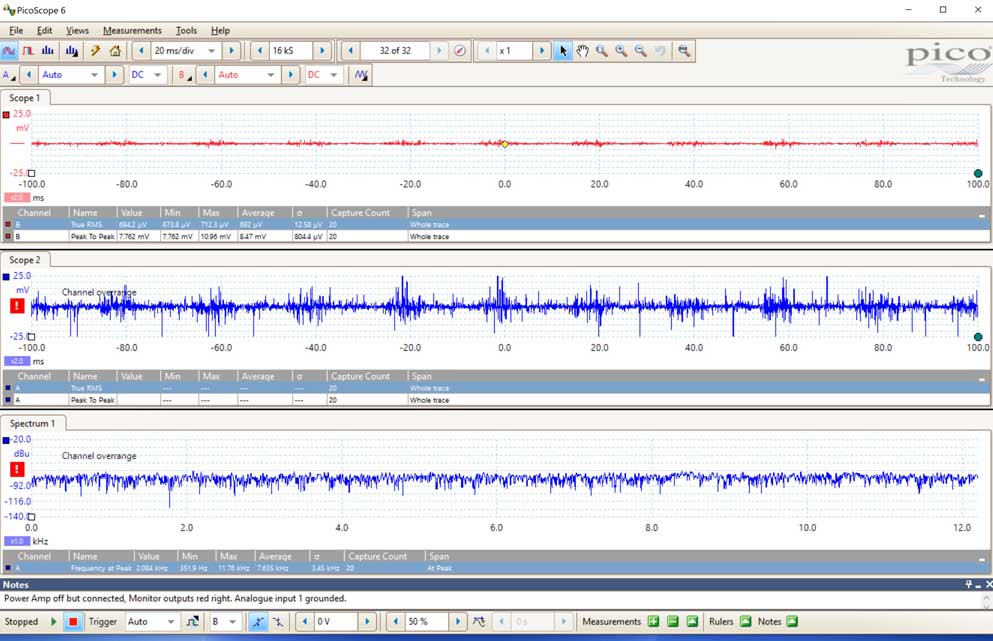 ------------- Peter --------------------------------------- Dual 505-1, Cyrus CD T, DIY 80W MosFet amp and PreAmp, 2xKEF 103.2 |
Posted By: peterb
Date Posted: 04 Mar 2017 at 6:34pm
|
I started with the same logic as you Richard but then the levels changed with no changes to the Pre ?? I might run a temporary spur from the consumer unit as a test, but not until the family are out for the day! ------------- Peter --------------------------------------- Dual 505-1, Cyrus CD T, DIY 80W MosFet amp and PreAmp, 2xKEF 103.2 |
Posted By: Richardl60
Date Posted: 04 Mar 2017 at 6:44pm
| Or you could try unplugging EVERTHING from your mains? |
Posted By: Richardl60
Date Posted: 04 Mar 2017 at 6:45pm
| Or you could try unplugging EVERTHING from your mains? Any chance neighbours could be an issue? |
Posted By: peterb
Date Posted: 04 Mar 2017 at 6:53pm
|
A temporary spur would be less work! Yes, could be a neighbour. We live in a rural spot, overhead supplies and lots of 'odd' wiring setups for the local farm and workshops, so a real possibility. All of which made me lean to towards using a conditioner. ------------- Peter --------------------------------------- Dual 505-1, Cyrus CD T, DIY 80W MosFet amp and PreAmp, 2xKEF 103.2 |
Posted By: Graham Slee
Date Posted: 05 Mar 2017 at 6:13am
|
78XX voltage regulators often produce that sort of pattern usually to a maximum of 3.5mV. What does your scope read? (and 79XX) ------------- That none should be able to park up and enjoy the view without a smartphone and the knowledge in how to use apps |
Posted By: gwebster
Date Posted: 05 Mar 2017 at 10:34am
|
I'm living down a lane in the middle of a country estate with long overhead power lines feeding all the properties within the estate and an electric fence right next to me. Phone lines down here have a constant whistle that Openreach says is "acceptable". In spite of all this extraneous noise on feeds into the house, my recently built DIY phono/pre/power is silent. How is the power wired up from the PSU to the phono/pre and power amps? Correct routing of the power distribution (both ac and dc wiring) within the amps can make a huge difference.
Keep ac wires away from the dc wiring. If it needs to cross dc wires, do it at right angles Keep dc wires as far away from the big decoupling caps as you can 
|
Posted By: BackinBlack
Date Posted: 05 Mar 2017 at 11:55am
|
As Graham points out the noise is probably from the 78xx regulators. No amount of mains conditioning will remove this. If I my point you in the direction of what I think is Grahams own solution, see http://www.hifisystemcomponents.com/forum/phono-preamp-project_topic745_page4.html" rel="nofollow - https://www.hifisystemcomponents.com/forum/phono-preamp-project_topic745_page4.html. The Genera is shown about half way down the page. Providing that your current draw is of the same order you should notice an improvement. Happy soldering and ultimately listening, Ian ------------- Just listen, if it sounds good to you, enjoy it. |
Posted By: Fatmangolf
Date Posted: 05 Mar 2017 at 12:25pm
|
I'd second Ian's steer towards Graham's solution. ------------- Jon Open mind and ears whilst owning GSP Genera, Accession M, Accession MC, Elevator EXP, Solo ULDE, Proprius amps, Cusat50 cables, Lautus digital cable, Spatia cables and links, and a Majestic DAC. |
Posted By: peterb
Date Posted: 05 Mar 2017 at 12:33pm
|
Thanks everyone for their contribution. My scope is Picoscope 2205 which has a sensitivity of 10mV/div, just about good enough. Thanks for the link, I will study it. I have tried to follow those wiring assembly guidelines, hopefully visible in the pic below. All leads twisted. Signal leads screened. Crossing leads at right angles. AC concentrated to one area (RHS), and I even tried to allow for a steel screen to surround it, but not yet fitted. 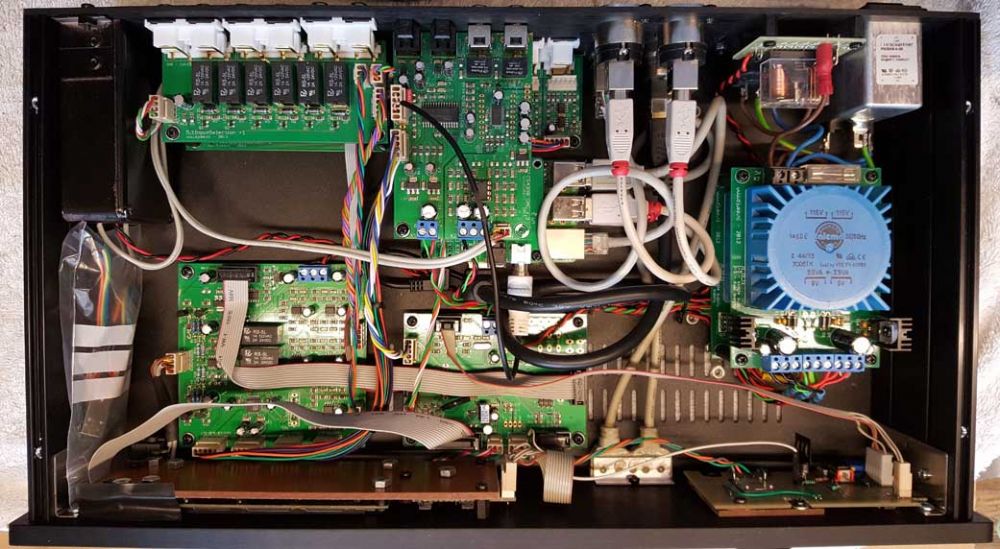 ------------- Peter --------------------------------------- Dual 505-1, Cyrus CD T, DIY 80W MosFet amp and PreAmp, 2xKEF 103.2 |
Posted By: Graham Slee
Date Posted: 05 Mar 2017 at 1:44pm
|
The 78s and 79s aren't fully stable, although the manufacturers say they are. Charging current happens 100 times a second as the diodes switch each ac cycle, so there is a top-up to the electrolytic "bulk" capacitors. The instantaneous part of the ripple voltage is fast and electrolytics are inductive, so there will be some high frequency noise. The bypass capacitor doesn't solve this, it only moves the noise higher in frequency. When we tested broadcast power supplies we tended to find the output noise increased onload, which verifies the ripple noise, there being more ripple on the bulk capacitors. Generally this wasn't a problem because the circuits being driven had massive PSRRs. Not so discretes unless built like opamps. The noise harmonics can go so high in frequency that the 78/79 are "trying" to operate outside spec, and being high gain amps in their own respect, will tend to ring on. They're also trying to pass this into a load capacitance which is also inductive. No surprise then to see ringing at the rate seen. Solution? It cannot be completely removed but judicious placement of low ohmage resistors in series with the electrolytics may help (1 to say 3.3 Ohms), and if you take a look at some Philips audio circuits, you can see where they put theirs. ------------- That none should be able to park up and enjoy the view without a smartphone and the knowledge in how to use apps |
Posted By: peterb
Date Posted: 05 Mar 2017 at 2:36pm
|
I have now read the Genera design thread, very interesting. I will see how destructive it will be to add some very small resistors to the PSU output caps, they can only help. One sentence in the thread rang a loud bell, "HiFi is listening to your PSUs" (I paraphrase). I seem to remember that this is the big USP given by Chord Audio http://www.chordelectronics.co.uk/chord-amplification-technology/" rel="nofollow - http://www.chordelectronics.co.uk/chord-amplification-technology/ When I first read it my initial reaction was, what a lot of trouble for a small improvement. But to quote someone else, much of this is making things better by marginal gains! At the end of the day the background noise it drowned, in a good way, when music is being played. It is just that I know it's there! ------------- Peter --------------------------------------- Dual 505-1, Cyrus CD T, DIY 80W MosFet amp and PreAmp, 2xKEF 103.2 |
Posted By: peterb
Date Posted: 20 Mar 2017 at 8:02pm
|
A quick follow up. I upped the Electrolytics to 220u and fed them from 2 ohm resistors. Where the resistors were added was determined by the pcb layout, on the +ve side it fed both the 100n and 220u, on the -ve side it just fed the 220u. The difference was not great but visible on the scope and discernible with 'my Ear In The Speaker' test. However one oddity occurred. In trying to get a clipped earth connection for the scope probe I moved it from holding against the 0V terminal of the PSU to clipping it to the 0V link on the PSU pcb. The noise level shown on the scope fell to almost nothing !! The hiss also all but disappeared from the speaker. The scope was my laptop running on its battery so it wasn't getting another earth. Don't understand that! ------------- Peter --------------------------------------- Dual 505-1, Cyrus CD T, DIY 80W MosFet amp and PreAmp, 2xKEF 103.2 |