Why Rumble Filters are bad
Printed From: Graham Slee Hifi System Components
Category: Turntable Audio
Forum Name: High Fidelity Turntable User
Forum Description: Technical Q&A, hints and tips
URL: https://www.hifisystemcomponents.com/forum/forum_posts.asp?TID=2842
Printed Date: 27 Mar 2026 at 4:02am
Software Version: Web Wiz Forums 12.01 - http://www.webwizforums.com
Topic: Why Rumble Filters are bad
Posted By: Graham Slee
Subject: Why Rumble Filters are bad
Date Posted: 07 Mar 2016 at 7:47am
|
Why Rumble Filters are bad... The beginner to records might think a rumble filter to be a good idea because it attenuates warps and bearing noise. However, it isn't all that clever because it also attenuates the low bass frequencies -- and worse. You could argue that your speakers only go as low as 75 cycles (which isn't low bass), so what does it matter? And if so, why are you concerned your cones flap with such low energy? To attenuate "rumble" the filter must have sharp cut because the frequencies where warps and bearing noise happen is only a couple of octaves below the lowest piano note, if that. With a first order filter you're only going to get 12dB attenuation (6dB per octave) so the "rumble" will only sound just less than half as loud. The phase shift however is 45 degrees at the filter turnover so if it's at say 27 cycles (lowest piano note), the low frequency phase response is going to be out up to around 270 cycles (where it's 6 degrees out).  Phase response The effect it has is on perceived timing: your hearing is so sensitive that it can detect such phase differences and tell you where the sound is relative to other sounds.  Phase shift Taking phase differences to extremes you get the phasing or "flanging" effects such as you'll hear on records such as Skywriter (Jackson Five). This demonstrates how changes in time alignment can be heard. As a musical effect it's OK, but distorted otherwise. To get more "rumble" attenuation means using more filter sections than a simple first order filter. Each additional section displaces the phase reponse another 6 degrees at frequencies 10 times that of the filter turnover frequency. So in-between we will hear the effect of phase shift - but not musically like the Jackson's hit - it will just sound out of step - so wrong. But also consider this: the record companies started to record with bass cut also. This was around the beginning of the microgroove record, so virtually all your records have some bass cut which simply isn't equalised in the RIAA stage, because it's in addition to the recording curve. Why did they do it? To squeeze more playing time per side. With the introduction of CD such bass cut became evident because CD didn't have the groove restraints of vinyl. A rumble filter simply adds to the bass cut making your already "cut" records sound bass light. Plus, it "time-steps" the bass in relation to the higher frequencies (where our hearing is most sensitive) so much so it can confuse the ear into believing the bass is playing out of tempo. So rumble filters are a bad idea IMO. But if you're getting cone flap and you're worried about damage to your woofers (which you shouldn't be unless they're audibly hitting the stops), then it isn't bearing rumble. What it is, is arm/cartridge resonance, where warps make the arm/cartridge exagerate the warp. This is where you need to select your arm and cartridge carefully. It's OK chasing after review hype, but if it leads to a mismatch then you're simply not going to get good results. Here I'll hand you over to the experts who will explain that. See: http://www.ortofon.com/support/support-hifi/resonance-frequency - http://www.ortofon.com/support/support-hifi/resonance-frequency In most cases a rumble filter is a sticking plaster get-by. Better to do without. ------------- That none should be able to park up and enjoy the view without a smartphone and the knowledge in how to use apps |
Replies:
Posted By: morris_minor
Date Posted: 07 Mar 2016 at 8:32am
That was a blog post if ever I saw one, Graham! And a very enlightening one too . .  ------------- Bob Majestic DAC/pre-amp Accession MC/Enigma, Accession MM, Reflex M, Elevator EXP, Era Gold V Solo ULDE, Novo, Lautus USB and digital, Libran balanced, CuSat50 2 x Proprius + Spatia/Spatia Links |
Posted By: Ash
Date Posted: 07 Mar 2016 at 9:14am
| Phase shift huh. Reminds me of listening to the HD800. It had a slightly musically withdrawn character IMO, as if it was out of tempo. Certain types of music, such as jazz with a deep rhythmic bassline (e.g Blu Swing -Revision) made this more obvious although even some solo piano seemed out of focus too. Must've been phase shift as my HD540II, K1000 and other previous test headphones all had a very focussed rhythmic response. |
Posted By: DaveG
Date Posted: 07 Mar 2016 at 1:39pm
|
Definitely worth paying attention to imo. It's easily overlooked - I must admit I had no idea about this for years. With a little planning & the above knowledge you can make an informed choice to minimise the risk of any problems, got to be better than applying a compromised electronic fix anyday. There are several free online calculators that do the maths in the Ortofon link for you. In my case the resonant frequency was exactly where the calculator predicted to it would be (I checked using the HFNRR test record). Some people add a wee bit of mass to ther headshell to tweak an existing set up. ------------- Dave Michell Gorbe + HR PSU -> Cadenza Bronze -> SME V -> Elevator -> Accession -> Proprius -> B&W CM6 s2 | Cusat 50 & Spatia cables -> 
|
Posted By: BAK
Date Posted: 07 Mar 2016 at 2:13pm
|
Graham wrote... "This is where you need to select your arm and cartridge carefully." So is there a formula we can use to get the cartridge and arm weights and dimensions correct? As in "with a given arm length and mass" you need a cart with this mass and compliance. I just found such a formula on the Ortofon link above. ------------- Bruce AT-14SA, Pickering XV-15, Hana EL, Technics SL-1600MK2, Lautus, Majestic DAC, Technics SH-8055 spectrum analyzer, Eminence Beta8A custom cabs; Proprius & Reflex M or C, Enjoy Life your way! |
Posted By: ServerBaboon
Date Posted: 07 Mar 2016 at 2:28pm
|
This from a Customer or Reviewer? I know of one reviewer who actually bemoans lack of rumble filter, never mind if its SS and not valves, maybe he just needs it for his older model turntable. ------------- Steve ------------- Various bits of GSP Kit ..well two so far, unless you count the cables that is. |
Posted By: Drewan77
Date Posted: 07 Mar 2016 at 3:45pm
I had always found the reckoner on the Vinyl Engine forum to be helpful. Here's a screenshot of a calculation I made a couple of years ago. It compares well with the result from using the HiFi News LP test track (10.91-11.04 vs 11Hz when the cantilever/cartridge oscillated)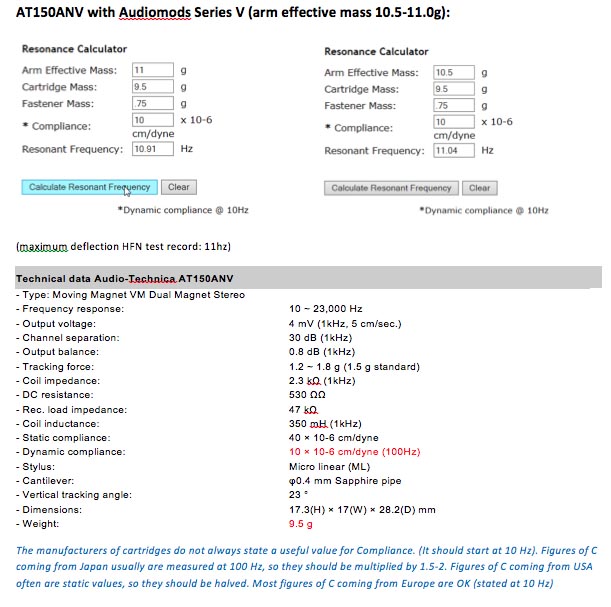 ------------- Older than I once was, younger than I'll be ............................. Andrew |
Posted By: Drewan77
Date Posted: 07 Mar 2016 at 4:05pm
|
http://www.vinylengine.com/cartridge_database_tools.php - http://www.vinylengine.com/cartridge_database_tools.php
------------- Older than I once was, younger than I'll be ............................. Andrew |
Posted By: BAK
Date Posted: 07 Mar 2016 at 4:14pm
|
So if a cartridge has a manufacturers' spec of "17 cu" what does that mean? What would that be equal to in " x 10-6 cm/dyne" ? or even in " µm/mN " ? ------------- Bruce AT-14SA, Pickering XV-15, Hana EL, Technics SL-1600MK2, Lautus, Majestic DAC, Technics SH-8055 spectrum analyzer, Eminence Beta8A custom cabs; Proprius & Reflex M or C, Enjoy Life your way! |
Posted By: Richardl60
Date Posted: 07 Mar 2016 at 8:19pm
|
Couldn't agree more over low filters whether they be switchable or built in. As you say proper matching should avoid issues. I do feel in the MP3 age a lot of people are accustomed to dialling out any meaningful bass, you only have to look at the LCD TVs although others will dial in silly bass with a sub to overcompensate. Wasn't aware of the phase shift argument does apply to High filters too? Richard |
Posted By: BAK
Date Posted: 07 Mar 2016 at 8:22pm
A Vinyl Engine member replied saying "@ 10 Hz, 17cu = 17 x 10-6 cm/dyne = 17 um/mN ". They are apparently all the same ! Interesting ! Still I am not knowing what the "cu" unit means... Compliance Units maybe? Using that figure; The formula on: http://www.ortofon.com/support/support-hifi/resonance-frequency - http://www.ortofon.com/support/support-hifi/resonance-frequency (my result = 8.8995 Hz ) Confirms the same answer as from Vinyl Engine's online calculator to within 0.01% or less difference : http://www.vinylengine.com/cartridge_database_tools.php - http://www.vinylengine.com/cartridge_database_tools.php (my result = 8.89 Hz ) I will take it as 8.9 Hz . Another trusted and experienced source advised me that the calculation results are always lower than the actual reality as found with the HiFi News test record using the lateral resonance test (on Side 2, Track 2 ). I think, I will have to run that test with a frequency counter to find out as I watch the cartridge lateral vibration. ------------- Bruce AT-14SA, Pickering XV-15, Hana EL, Technics SL-1600MK2, Lautus, Majestic DAC, Technics SH-8055 spectrum analyzer, Eminence Beta8A custom cabs; Proprius & Reflex M or C, Enjoy Life your way! |
 BAK wrote:
Posted By: BAK
Date Posted: 07 Mar 2016 at 8:40pm
All filters cause a phase shift. This is due to the fact that reactive components, capacitors and inductors, are not perfect... they have a changing phase lead or phase lag at differing frequencies. Examples: High filters will cause a phase shift up to 2 or 3 octaves below the -3dB frequency. Speaker crossovers are designed to crossover @ a frequency 2.5 octaves minimum above the tweeters resonant frequency. Input coupling capacitance combined with the input resistance are selected in a similar manner, to pass a frequency much lower than the lowest frequency needed to be coupled, usually 1/10th (to couple down to 10 Hz it would be designed for 1 Hz). ------------- Bruce AT-14SA, Pickering XV-15, Hana EL, Technics SL-1600MK2, Lautus, Majestic DAC, Technics SH-8055 spectrum analyzer, Eminence Beta8A custom cabs; Proprius & Reflex M or C, Enjoy Life your way! |
Posted By: morris_minor
Date Posted: 10 Mar 2016 at 4:34pm
|
FYI: http://www.blog-gspaudio.co.uk/why-rumble-filters-are-bad/ - http://www.blog-gspaudio.co.uk/why-rumble-filters-are-bad/ ------------- Bob Majestic DAC/pre-amp Accession MC/Enigma, Accession MM, Reflex M, Elevator EXP, Era Gold V Solo ULDE, Novo, Lautus USB and digital, Libran balanced, CuSat50 2 x Proprius + Spatia/Spatia Links |