Digitising LPs - a question for Graham
Printed From: Graham Slee Hifi System Components
Category: Digital Audio
Forum Name: CD, DVD Audio, DACs, ADCs and Digitizing
Forum Description: The existing (and obsolete?) digital formats
URL: https://www.hifisystemcomponents.com/forum/forum_posts.asp?TID=1278
Printed Date: 27 Mar 2026 at 2:27am
Software Version: Web Wiz Forums 12.01 - http://www.webwizforums.com
Topic: Digitising LPs - a question for Graham
Posted By: tg [RIP]
Subject: Digitising LPs - a question for Graham
Date Posted: 28 Dec 2011 at 1:26pm
|
In perusing and experimenting with various methods of doing this, I have occasionally come across the idea (which I have not tried) of recording direct without RIAA equalisation and then applying that equalisation in the digital domain. I would be interested, as I imagine, would be others, in Grahams thoughts on this approach and its merits or failings. |
Replies:
Posted By: Graham Slee
Date Posted: 28 Dec 2011 at 7:45pm
|
You'd need an extra 40dB of dynamic range/headroom because the output of a magnetic cartridge rises with frequency... ...turning this (the actual output from a RIAA record):  ...into this:  For those who don't understand it, if you were to play a record with a cartridge having a "flat" response, such as a condenser/ceramic or crystal cartridge (good luck finding a good one these days) you'd have a near "flat" frequency response. Like an car alternator without a regulator, the faster it turns, the higher the voltage. So the higher the frequency, a magnetic cartridge puts out proportionally more. The range 40dB equates to a ratio of 100:1. The reason why the "flat" output in graph 1 (which is graph 2 rotated +45 degrees) is so bumpy is because the cutter head is driven by coils (it's a solenoid) so it is highly inductive, and without additional signal conditioning (a bit of low bass boost and treble boost in the cutter head amp) it would simply resemble a hill, like really ancient records do. The RIAA curve came into being 1953 using "appropriate technology" of the day. They thought a +/-2dB accuracy was good enough - after all, they had tone controls in those days. Still, 58 years later, nobody has been able to make anything better! Edit: (Friday 30th) Nostalgia. If you want the sound of a lovely old warm sounding Dansette or you long for the sound of a good-ol ceramic cartridge the phono preamp doesn't need all those "tucks and curves" just a single pole 6dB per octave roll-off  ------------- That none should be able to park up and enjoy the view without a smartphone and the knowledge in how to use apps |
Posted By: Fatmangolf
Date Posted: 29 Dec 2011 at 8:45pm
|
I tried mic preamp and ADC then applied a digital filter based on RIAA with the cutter head bump. Whilst this was only as good as my skills, my addition to the wise words above is that Reflex M followed by ADC sounded much better for less work.
------------- Jon Open mind and ears whilst owning GSP Genera, Accession M, Accession MC, Elevator EXP, Solo ULDE, Proprius amps, Cusat50 cables, Lautus digital cable, Spatia cables and links, and a Majestic DAC. |
Posted By: tg [RIP]
Date Posted: 29 Dec 2011 at 11:11pm
|
Hmmmmmmmm, I have been pretty satisfied with the results of feeding the Reflex into an M-audio firewire interface (though not as good as just playing the record) - but being at a loose end for a day or two Source of the question was the Terratec DMX 6 Fire and Phase 26 USB both of which I own (as also the newer - "I want" DMX 6 Fire USB {24/192 I/O, 48V Phantom power for Mic all singing all dancing}), appear, from the rather scant documentation, to utilise this method. Specs quote the phono inputs as 47Kohm impedance and sensitivity to suit MM or HOMC cartridges, there is a button on the control panel (software) for "RIAA Filter" but the rather cryptic documentation hints that this is for monitoring only and the "howto" guides one to use the provided Wavelab Lite software to apply RIAA correction using a .dll provided as a post-processing filter. Down the rabbit hole we go - using ASIO drivers is a "good thing", but being Steinberg proprietary, not all software can use them, notably the freeware Audacity (Steinbergs licensing conflicts with the Audacity license) BUT - it is possible to "roll your own" for personal use (I believe). My usual preferred, minimalist recording software, offers auto level setting, auto start and auto stop - all quite handy in a stripped down interface uncluttered with all the paraphernalia of Audition or Sound Forge and the like. Sadly, it does not support ASIO nor high bitrates, which I rather prefer for initial "takes", no harm in down sampling to 16/44 later. Why now ? - some other darn fool wanted to do some archiving and this one opened its big yap and volunteered to help out - I predict much regret of this impetuousness in the coming days. Trouble with this stuff and software and 'puters in general, it is the stuff they don't tell you that you REALLY DO need to know to get it all to work and the only way to find out that stuff is to try all the wrong ways and any other avenues of frustration that offer themselves in the process. Probably not much different to designing phono stages and headphone amps and such eh? That's about enuff from Groucho as he goes orf to make 'is Marx - Lang may yer lum reek. Oh BTB, had the lid off the Phase 26 (don't ask) and was impressed to see what appeared to be a decent looking digital pulse transformer on the coax out. Let you all know how it went when I am done driving myself further round the bend. |
 I have taken it into my foolish mind to tinker some more.
 - maybe this should have gone in Krabby Patty.
Posted By: Fatmangolf
Date Posted: 30 Dec 2011 at 3:09pm
|
Best of luck with that Tony. I share your usual approach of less is more on ripping vinyl but would be interested in knowing how it goes.
Jon ------------- Jon Open mind and ears whilst owning GSP Genera, Accession M, Accession MC, Elevator EXP, Solo ULDE, Proprius amps, Cusat50 cables, Lautus digital cable, Spatia cables and links, and a Majestic DAC. |
Posted By: oldagetraveller
Date Posted: 31 Dec 2011 at 2:01pm
|
My method, for years, has been to record direct to recordable audio c.d. using an old Philips c.d. recorder/player connected to the tape in/out on my pre-amp. The results are very good. The c.ds may, after finalising, then be played in car or converted to MP3 (highest quality) for adding to my MP3 player. ------------- Peter P T- LPT/RB300/G1042, Pink Triangle Tarantella/Nima/Ortofon 2M Black, SL1210II, Naim CD5, NAC112, NAP150, Flatcap2, Proac SC1, GS SoloUL,GS Accession , Senn HD250 & HD540. |
Posted By: Graham Slee
Date Posted: 01 Jan 2012 at 7:43am
|
I think we need to define what is meant by "flat" when we talk about subjects like this. I get a few emails asking me if I can make the Revelation or Jazz Club do "flat" to suit old acoustic records on 78. "Flat" on a magnetic cartridge is always going to give a treble heavy/bass light output regardless of recording EQ, electric or acoustic. In the case of an RIAA standard pressing the difference between the lowest bass and highest treble is 40dB - a ratio of 100:1. That is miles off being flat. Although the record amplitude itself is as near as dam it flat, the cartridge output, being a generator, goes up with increasing mechanical velocity - as frequency increases the stylus is moved faster, generating more voltage. In my opinion flat should mean the equalisation of the cartridge alone. Then the EQ needed would just be for the differences in record amplitude alone, and therefore the EQ could then be done in the digital domain. ------------- That none should be able to park up and enjoy the view without a smartphone and the knowledge in how to use apps |
Posted By: Graham Slee
Date Posted: 01 Jan 2012 at 8:55am
|
Following up on my previous reply I decided to see what would be necessary to do a "flat corrected" curve on the DIY Genera phono preamp so that a magnetic cartridge would reproduce any record output without any particular equalisation standard. In other words "flat" or the response you'd have gotten from a ceramic or crystal cartridge (but better "fidelity"). These are the component changes: C3 A&B: link C4 A&B: link R6 A&B: remove R7 A&B: 30 Ohms (33 Ohms will do) R5 A&B: 470k Ohms This gives a falling response from 35Hz (-3dB turnover point) at the rate of -6dB per octave to counter the rising +6dB per octave response of the magnetic cartridge. To go lower at the bass end - to cut from a lower frequency - would require a considerable rethink. The curve is shown below... 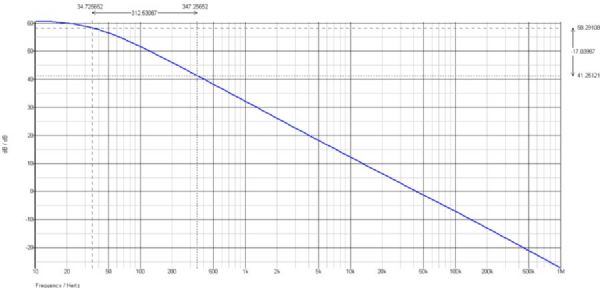 ------------- That none should be able to park up and enjoy the view without a smartphone and the knowledge in how to use apps |
Posted By: tg [RIP]
Date Posted: 01 Jan 2012 at 2:21pm
|
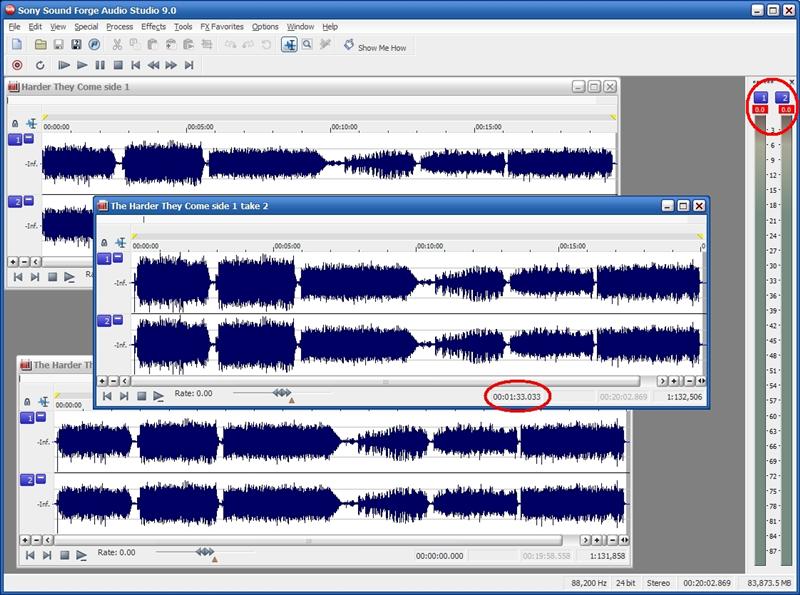
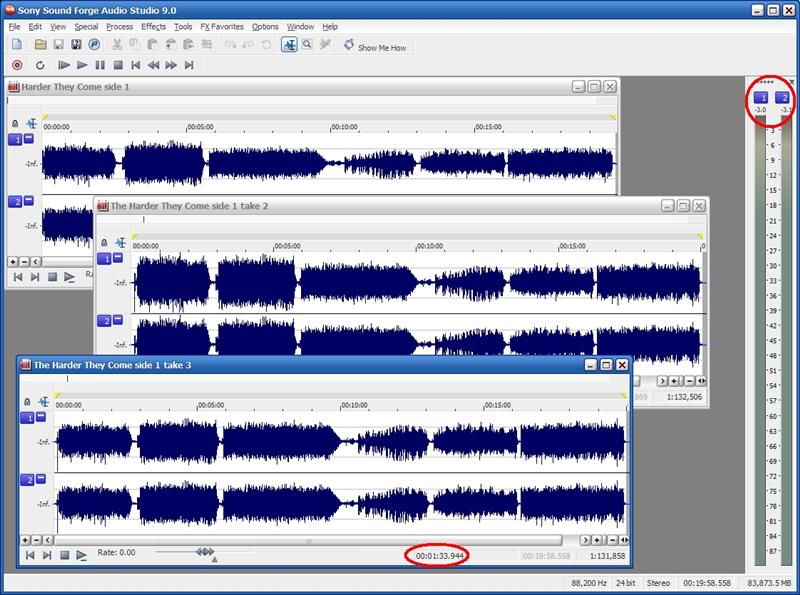
Finally used the Phase 26 USB to actually record a few takes of the same album today. Using the Technics with a DL110 and 1Kohm parallel load into the phono inputs of the unit. Using Sony Sound Forge Studio as the only software I had that could both use ASIO drivers and VST plugins, other software that looked promising could not use ASIO drivers or was looking like taking too long to work out how to use it (Ableton seemed to have a better interface to both the driver and the plugin but is geared to multitrack recording and mixing). Whatever, sound level good, without clipping being apparent, so boosted BUT NOT EQUALISED. This was quite easy to hear on playback, this is an album I already had a fairly good recording of to use as a reference. Ran the supplied RIAA plugin over the file et voila - does the business. Much fooling around with different post-processing and different sample rates, 24/88.2 and 16/44.1 both tried. Results yet to be fully evaluated, but appears to work as described, monitoring during recording via Solo/K701 did
Edited the above following further more careful evaluation. As Alice said, "it gets curiouser and curiouser" - stay tuned for further inciting instalments. Nearly forgot, Graham, that is very interesting what you have done to the Genera output, I am so glad I no longer have the one I built, I would likely think I needed to try that too. |

Posted By: tg [RIP]
Date Posted: 14 Jan 2012 at 2:17am
|
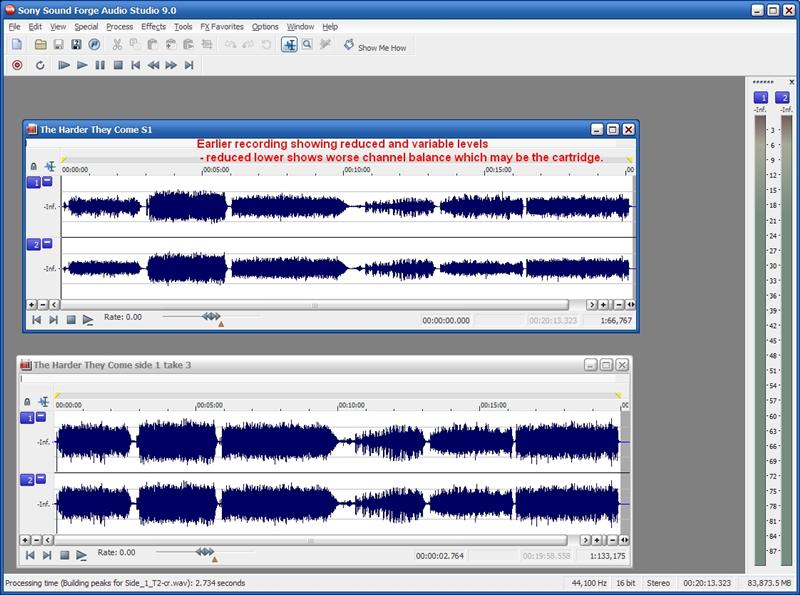
One unexpected outcome from the above fooling around, I noted the output of one channel to be perhaps -3dB cf the other over several different records. A careful check of azimuth setting on the headshell in question, followed by a slight adjustment (the headshell offers azimuth adjustment) resulted in nearly perfect channel balance. With, naturally, a rather better centred image (although that is often suspect in my system due to speaker placement constraints - one reason that I like - where possible - to have a balance control). The wonders of technology Of course I had to then re-record the sides with mismatch The hardest part of this whole exercise has been achieving an input level that does not clip. I would much prefer to use the Reflex for phono pre duties but cannot lower the output sufficiently with means at hand (available preamps are not sufficiently transparent and tend to remove most of the advantage in SQ of using the Reflex) - the latest - USB2 capable - interface from Terratec offers onboard gain controls which might be good. Perhaps the Aria will be available soon and might be OK for the purpose. |
Posted By: tg [RIP]
Date Posted: 23 Jan 2012 at 12:21am
|
Interesting find on tnt-audio http://www.tnt-audio.com/sorgenti/rip_it_4_e.html" rel="nofollow - http://www.tnt-audio.com/sorgenti/rip_it_4_e.html a 4 part series covering various experiments over a number of years. He has tried a few of the same pieces of gear that I have although ending with a rather more expensive solution. He also identified the same input level control issue and recommends the same click removal software that I prefer. Of particular interest, to me at least and hopefully to anyone else reading this, the page linked covers various software applications available, with some testing methodology for their accuracy and usage, most especially WRT sample rate conversion performance. There is also a deal of useful information concerning the use of higher accuracy sampling rates during the digital processing phase, prior to downsampling to Redbook and the desirability of doing all digital manipulation in 32bit floating point. I found this information both readily accessible and easily digested, there are also links to further reading on the subject. |
Posted By: Fatmangolf
Date Posted: 24 Jan 2012 at 9:58pm
|
Thanks Tony, that is a very helpful resource. ------------- Jon Open mind and ears whilst owning GSP Genera, Accession M, Accession MC, Elevator EXP, Solo ULDE, Proprius amps, Cusat50 cables, Lautus digital cable, Spatia cables and links, and a Majestic DAC. |
Posted By: Fatmangolf
Date Posted: 23 Mar 2012 at 6:33pm
|
I have one of the same soundcards as Tony and had forgotten this thread. More thanks and recommended for a sticky! ------------- Jon Open mind and ears whilst owning GSP Genera, Accession M, Accession MC, Elevator EXP, Solo ULDE, Proprius amps, Cusat50 cables, Lautus digital cable, Spatia cables and links, and a Majestic DAC. |
Posted By: Fatmangolf
Date Posted: 23 Mar 2012 at 7:01pm
|
I have made up a couple of phono leads to connect my Reflex M to my M-Audio 2496 with some attenuation of about -10dB built in. I record at full level and then boost by a few decibels if necessary for quieter LP's. ------------- Jon Open mind and ears whilst owning GSP Genera, Accession M, Accession MC, Elevator EXP, Solo ULDE, Proprius amps, Cusat50 cables, Lautus digital cable, Spatia cables and links, and a Majestic DAC. |
Posted By: Frostg
Date Posted: 23 Mar 2012 at 10:46pm
| Thanks for pointing me back to here Tony. Now to see what can be done without fancy sound card, I just have a Mac mini, or is it a mini Mac! |
Posted By: tg [RIP]
Date Posted: 24 Mar 2012 at 2:53pm
|
If there is interest, perhaps this thread could move in the direction of some "how to" type tips. My first in that direction focuses on the source, GIGO is very apt here and the first step to satisfying results is the cleanest possible record that can be made from what is to be recorded. This applies regardless of whether the record is new or used. Wash the record, play it a couple of times and check for improvement in SQ, rewash if it is felt that further improvement may be possible (for new or mint condition records NO extraneous noise should be acceptable), play at least twice more. During replay after cleaning, there will be noted a continuing improving in SQ for the first 3 - 4 plays, this may be, in part, due to the stylus removing "gunk" loosened by the washing, but I feel there is another mechanism in play here and it is referred to in the excellent articles by Rudolf Bruil on his website http://www.soundfountain.com/amb/rc1.html" rel="nofollow - http://www.soundfountain.com/amb/rc1.html Following the cleaning and replay routine, I then apply Last record preservative, which, to my hearing, does "what it says on the tin" - providing a fuller and smoother sound, exactly as one might expect from the stylus pressing against/being moved by, a less yielding surface. All that and not a computer in sight yet Who knows, do all that and you might forget the idea of trying to digitise them altogether. If not, watch for further installments. |
Posted By: Frostg
Date Posted: 24 Mar 2012 at 10:09pm
|
Thanks Tony, very informative. Any how to on how to wash a record? Assume it is not put it in the bath with my daughter and her bubble bath! 
|
Posted By: Fatmangolf
Date Posted: 24 Mar 2012 at 10:31pm
|
I agree with Tony that clean records sound better and record better. I had a few LP's cleaned and was persuaded. I bought an Okki Nokki RCM and use their solution (soak for longer on old/dirty records) suck, then distilled water and suck. There are other ways to clean records. There is a Jim Lesurf posting on the S/N improvement if anyone wants to see graphs/dB empirical stuff. ------------- Jon Open mind and ears whilst owning GSP Genera, Accession M, Accession MC, Elevator EXP, Solo ULDE, Proprius amps, Cusat50 cables, Lautus digital cable, Spatia cables and links, and a Majestic DAC. |
Posted By: tg [RIP]
Date Posted: 24 Mar 2012 at 11:53pm
|
Aside from the various RCMs available at prices from a couple of hundred dollars to many thousands of dollars, there are various manual or semi-manual methods of cleaning records. The method with which I have been happy for several years combines products from 2 different suppliers. I use the hardware (trough, drying rack & record label clamp) from the Knosti system, which I tried but was not completely happy with, as a post wash rinse bath. Use distilled or filtered water in the trough and tip it out after 10 - 15 records or after a cleaning session. The actual cleaning I do using the Disc Dr cleaning solution and brushes, the brushes have replaceable pads and will last a long time, you may prefer a DIY cleaning solution, there are many recipes to be found for that. I clean one side, turn over and clean the other side, then rinse and air dry. The record is laid on a soft and fully supportive surface such as a clean towel or similar on a table top during the cleaning and held down to the surface by manual pressure on the label area whilst "scrubbing", the majority of the cleaning solution is removed from the surface using the cleaning brush prior to turning over, at which stage the surface will be moist rather than flowing wet. Occasionally there will be sticky muck on a record that may require solvent removal, isopropyl alcohol (or even methylated spirit) will often loosen these. The record is then washed with the normal cleaning solution, rinsed and air dried. Where records have only a paper sleeve, I will put them in a good quality poly sleeve after cleaning, since paper sleeves will abrade and leave mould feeding debris in the grooves. I keep on hand a pack of new sleeves for such replacements and for replacement of any no longer serviceable poly sleeves from S/H acquisitions. There have been articles on the net WRT the use of small portable manual steam cleaners for record cleaning, this is not something I have tried, but could be worth investigation with the obvious proviso that this method may entail some risk if insufficient thought were given to the possible effects of over enthusiastic application. eg HOT steam + vinyl = potential damage. I also regularly use a carbon fibre brush to remove static and airborne dust from the record surface immediately prior to play, a light touch on the turning record combined with a rolling action of the brush will lift most of this. For records holding a static charge, I have found the Milty anti-static pistol effective, this is not commonly a problem for me here and is more common in air-conditioned or centrally heated environments I think, decent anti-static sleeves are also a help. The bath tub idea might be a lot of fun but could introduce some undesirable factors detrimental to optimal sound quality, aside from hazards to baby, bathwater and the record label. Will get round to some of the hardware stuff next. |
Posted By: Fatmangolf
Date Posted: 26 Mar 2012 at 5:48pm
|
Thanks again for this guidance Tony. ------------- Jon Open mind and ears whilst owning GSP Genera, Accession M, Accession MC, Elevator EXP, Solo ULDE, Proprius amps, Cusat50 cables, Lautus digital cable, Spatia cables and links, and a Majestic DAC. |
Posted By: garygillespie
Date Posted: 28 Mar 2012 at 8:27pm
|
TG, It seems you use some of the same stuff I do, but you are way more advance then me. Have you used the spectrum analysis in sound forge? I want to see if the quality of my vinyl rips have gone up with each new piece of equipment I buy. |
Posted By: tg [RIP]
Date Posted: 29 Mar 2012 at 12:19am
|
Gary, not to put the dampener on your technical enthusiasm at all, but my reference for improved quality of vinyl digitisation is the original recording. If I play both on my system I can tell how good my rip (and my DAC) are. I am not sure how one might use spectral analysis for relative SQ analysis. If I cannot hear an improvement when I play back and compare to the original, then, to all practical purposes there is none. If it sounds better (than the original) then there is a problem Have fun anyway. |

Posted By: tg [RIP]
Date Posted: 01 May 2012 at 1:07pm
|
Seems about time for some further guff in this thread so here are a few more thoughts. Having taken care of the primary source, we are at the stage of creating an input signal for recording. The objective here being to provide the best possible signal to the ADC. Most phono preamps are of fixed gain, phono cartridges vary widely in their output level and recordings also vary widely in their average level, so the output from the phono stage will also vary quite a deal from a nominal "line level" as might be required by the input to an ADC. Certainly IME the output from the cartridges I most commonly use, when passed through a Reflex, provide an output that is "too hot" for direct input to my PC interface/ADC resulting in "clipping" of the recorded signal. I have posted links in another thread regarding optimal input levels but will repeat one of them here http://www.massivemastering.com/blog/index_files/Proper_Audio_Recording_Levels.php - http://www.massivemastering.com/blog/index_files/Proper_Audio_Recording_Levels.php well worth the time to read and digest. It would seem to me that the optimal, least harm, approach here, is to reduce the signal level in the analogue domain prior to input to the ADC at a level optimal for it and not to use any level control provided in software for that interface, but to leave it set to full range. I am aware of some recording interfaces having their own phono preamp and onboard input level control attenuator, these would provide what is required, analogue attenuation at input. My own and many others do not have such control. Essentially then, this requires the ability to attenuate the signal between the phono pre and the ADC input, for many perhaps the simplest method will be to take the signal from a preamp output and control that with the preamp volume control. In my own system I have yet to hear an active preamp that does not take something away from the signal. That includes a preamp I obtained many years ago from a recording studio and a couple of far from inexpensive preamps I have trialled at one time or another, the difference being both audible and detrimental in all cases. I am therefore reluctant to use that method. Inline attenuators of the fixed variety will also inflict some detriment to the signal, but probably not as great as most active preamps. Their greatest advantage after ease of use being their relatively low cost. They do not offer much in way of flexibility however. If the amount of attenuation were to be fixed, then a high quality solution might be DIY assembled using high quality resistors such as Vishay Z-foils. The one device I have successfully inserted into my system between source and amp with no apparent detriment to the sound, has been the Burson buffer I purchased some years ago to aid the output of my then DAC. That now being surplus to requirements I have fitted a 100K stepped attenuator between its inputs and the active circuitry and am hoping this will provide both the transparency I want and the flexible attenuation I need for this application. With very low output Z and 100K input it offers the flexibility to be placed either between Reflex and ADC or, with suitable load adjusting plugs in parallel, between turntable and phono stage. A DIY TVC might be another viable option, as might be an LDR type device, I have not investigated the possible drawbacks to these approaches, but suspect that impedance matching might be an issue. Basically I prefer the attenuator -> buffer arrangement however it might be achieved, this does provide the best impedance matching between devices. I have long been interested in the passive, buffered linestage in the following article - http://www.stereophile.com/solidpreamps/54/index.html - http://www.stereophile.com/solidpreamps/54/index.html - unfortunately a number of the components are now no longer available and I have not taken the time to pursue suitable alternatives, but I have seriously considered that this might be a solution to the preamp issues I have noted above. In all of this, I am trying to keep the focus at the enthusiast level of equipment and options and not considering more professional grade equipment that might be beyond the budget of many (me included), particularly for the occasional project. Edited for inclusion of additional content and to correct some spelling. |
Posted By: zwazoo
Date Posted: 12 May 2012 at 2:33pm
|
tg, I agree, based on my experience digitizing audio over the past 10 years or so, obtaining an acceptable input signal for recording is the greatest challenge. I have worked with tapes, cassette and reel to reel; and vinyl using various ADCs with a constant issue related to input signal level and noise. My experience has convinced me, it is an impedance mismatch issue between our phono preamp outputs and whatever type of ADC we connect with. Your point about the buffer is a good approach to try. It could provide the impedance match or correction allowing signal from your phono to fit, so to speak, nicely into the window provided by your ADC, therefore cleanly digitizing the signal maintaining minimal loss. I have been trying to find the matching capability with the output of the phono preamp. What we do, digitizing vinyl, does not generate enough interest in the marketplace for a vendor to spend their resources developing products specifically for our application, especially within your “enthusiast level” focus. Therefore, it is up to us to find the solution and apply it. Just look at the compromises we make to do this, yes I appreciate the challenge, but I also have years’ worth of vinyl to deal with. I have modified my phono preamps over the years as my ADCs have changed, but I’ve never felt confident I ‘m getting the best sound. I have been very interested in Graham’s discussions concerning a phono preamps design and the theory behind it. His insight has helped answer numerous questions I have had over the past years concerning problems with level matching between my phono output and the ADC. I look forward to discussing this down the road. Tom |
Posted By: tg [RIP]
Date Posted: 13 May 2012 at 12:57am
|
Hi Tom, welcome to this forum. It will be good to have some more contribution on this topic. enjoy your time here, Tony G |
Posted By: Graham Slee
Date Posted: 20 May 2012 at 8:49am
Going back to the original question...
The output of a magnetic cartridge as established already is a rising one where the highest frequency in the accepted audio range - 20Hz to 20kHz has 1,000 times the amplitude of the lowest frequency. Because of the "tuck and nip" of the RIAA recording curve the actual output playing a record will give a range of 100:1, or in decibels: 40dB. The analogue input to an ADC (analogue to digital converter) chip is 2 volts peak to peak in the case of a Texas Instruments PCM2902. In r.m.s. that is approximately 700mV. It should be similar for most chips as all now seem to work on a 3.3V supply. 700mV r.m.s. is therefore the maximum the ADC input will take before clipping. The input would have to be adjusted down to cater for the dynamic peaks of the record. If reduced by -14dB which seems to be the "pre loudness wars" input level, the input at -14dB is 140mV. 140mV is therefore the input level to the ADC input at 20kHz and therefore the input at 20Hz is 1/100th of 140mV which is 1.4mV. In decibels that is -54dB. If the dynamic range of the ADC is 16 bits there is 96dB dynamic range. At -54dB there is 42dB left. In this 42dB has to fit the low frequency (20Hz) dynamic range less the peaks. Beyond that is the noise floor which is different from an analogue noise floor - in digital nothing can exist at or lower than the noise floor. If 42dB is considered sufficient then noise wise the idea seems OK. However, please do not forget that the distortion increases in proportion with falling digital signal level and may be in the region of 10% on the quietest lowest bass notes, whilst being much more respectable as frequency increases. ------------- That none should be able to park up and enjoy the view without a smartphone and the knowledge in how to use apps |
 tg wrote:
Posted By: zwazoo
Date Posted: 20 May 2012 at 3:54pm
|
I have tried an unequalized phono preamp for
digitizing vinyl. Adjusting the input levels on my ADC was really a pain.
Once I found a good setting, the digitized audio had high frequency distortion.
Suspecting an overdrive condition, I reduced the input gain only to find that when
the high frequencies were better, but the low frequencies were muddy. After
Graham’s explanation it seems maybe the phono preamp was producing a distorted
output. The phono preamp manufacturer blamed it on the ADC input circuit being
too sensitive. Using a properly equalized phono preamp produces acceptable results. Actually, it was the same device, a switch produced the "flat" circuit vs. the "normal" circuit. It seems that just as much care must be given to the design of these unequalized preamps to handle what is basically a highly complex signal as is required of equalized preamps. Something about if it’s not broken don’t fix it, or a solution looking for a problem. I do understand the claims that a software program can be consistent and doesn’t drift, etc., but the original method works just fine with properly designed phono preamps. My software screws around with my sound just about enough as it is. Tom |
Posted By: Graham Slee
Date Posted: 20 May 2012 at 4:50pm
|
Tom, I don't think it's your phono amp set to flat, but as I explained, the ADC input range is simply insufficient for the 100:1 level difference. If you set it so the highs are OK, then you'll have lows down in the distortion - distortion in the digital domain.
------------- That none should be able to park up and enjoy the view without a smartphone and the knowledge in how to use apps |
Posted By: zwazoo
Date Posted: 20 May 2012 at 5:30pm
|
Graham, I was just wondering depending on how the switch activated removal of the equalization circuit was placed in the circuit could cause an output impedance change such that it could cause distortion to the signal. Your explanation with actual electrical theory as apposed the more main stream explanations is refreshing and I now understand what the problems are. Could the "100:1 level difference" problem be solved with a phone preamp integrated into the ADC? Tom |
Posted By: tg [RIP]
Date Posted: 30 Nov 2012 at 5:16am
|
Long time with no input to this thread, I have now moved it to the more recently created digital audio forum under the appropriate heading.
A few more thoughts on this recent exercise when I gather it together. |
Posted By: Fatmangolf
Date Posted: 30 Nov 2012 at 8:26pm
|
Thanks Tony, this is very useful information. Jon ------------- Jon Open mind and ears whilst owning GSP Genera, Accession M, Accession MC, Elevator EXP, Solo ULDE, Proprius amps, Cusat50 cables, Lautus digital cable, Spatia cables and links, and a Majestic DAC. |
Posted By: Sylvain
Date Posted: 14 May 2013 at 3:47pm
|
Graham The 'Genera' was des9ged to be a capable , flexible . modification friendly to alow DIYers the opportuity customise to their specific requiremet ad your comprehensive narrative o the desig ad the rationale for every component got me excited and I jumped ad built ad happy.. Subsequently heard that you were producing a 'wonder' encapsulated little magic of components to add the ''valvee flavour'' but this never came about for the NOVO or the GENERA that I built. Now I am caught by another bug...digitizig Vinyl to 24/96 and i have researched all the Forum exchanges and again the comprehesive text you provided i the project. I list the issues as Follows:-
Of all my reserach You provide the most lucid explanation of the technical constraints and semm well glued and whilst some companies are ow producig ADC icorporated Phono are you likely to go down that road. IS THE GENERA 'Generic desig suitable for modification fo the purpose to icoorporate a ADC card and matchig with Stylus cartridege. Can you assist us ad those itrested ad ay plans for a KIT of the subject .. Regards and enjoy the rain in  doors with music. doors with music.Sylvain'
|
Posted By: Graham Slee
Date Posted: 14 May 2013 at 5:57pm
|
Sylvain, yes the valvee sound - I'd not forgot. It's just that time seems to fly doing my job - I wish it wouldn't... The donor op-amp needs to have certain characteristics for a phono stage more so than a line stage or headphone amp. This is because it has the job of charging and discharging the EQ network symmetrically and few op-amps can do that (and discrete circuits can be even worse!). I'm still hunting one that does the symmetry as well as having the necessary output current - plus the secret ingredient. The existing op-amp in the Genera does everything else. As is usual for me I like to see what my competitors do and then go the opposite direction . The phono stage ADC is something I've been investigating for a while now. It should hopefully happen this year, but 5 months of it are almost already gone, and I do have a pile of design work to get through this year.As for post ADC EQ, that should be a non-starter because of dynamic range limitations in the analogue domain. If you just count the dynamic range envelope for the signal you will need 40dB which is easy. But that does not consider the S/N ratio. Neither does it consider the vinyl noise (clicks and pops) whose rising edges are above 20kHz and that has to be equated with the rising response of a magnetic cartridge. For my standards of reproduction this is simply not feasible. Others may disagree but the proof is in the listening and from my previous experience I know it will not sound as good as I'd want it to be. ------------- That none should be able to park up and enjoy the view without a smartphone and the knowledge in how to use apps |